How Many Amps Does an Air Conditioner Use?
The amps your air conditioner uses depend on its type, size, and voltage. Small window units typically draw 5 to 7 amps, while larger window models require 10 to 15 amps. Central AC systems usually need 15 to 60 amps, based on capacity, often running at 240 volts to reduce current draw.
Startup amps can be two to three times higher than running amps. Knowing this helps you match your circuit safely and avoid overloads. You can also explore how these values influence efficiency and costs.
How Voltage and Amperage Work in Air Conditioners
Although air conditioners run on different voltage levels, understanding how voltage and amperage interact is essential for sizing your unit correctly and guaranteeing safe operation.
Air conditioners typically operate on either 110-120 volts or 220-240 volts, which directly affects their power consumption and efficiency.
Air conditioners run on 110-120V or 220-240V, impacting power use and efficiency.
The amperage draw, measured in amps, varies depending on the unit’s size and type. You use the formula Watts = Volts × Amps to calculate the electrical load.
Because startup amps can be several times higher than running amps, you must consider this when selecting your electrical circuit.
Larger units often require a dedicated circuit to safely handle their amperage demands and prevent overloads.
Proper circuit sizing guarantees your air conditioner runs reliably without tripping breakers or risking electrical hazards.
It’s all about keeping things safe and efficient.
Typical Amperage Usage by AC Type and Size
You’ll find that small window AC units typically draw between 5 to 7 amps.
On the other hand, larger models can require up to 15 amps or more.
When it comes to central air conditioners, they demand considerably higher amperage.
Usually, they range from 15 to 60 amps, depending on their capacity and voltage.
Mini-split systems fall somewhere in between those two.
Their current draws vary according to their size and efficiency.
Window AC Amperage Ranges
How much current does a window air conditioner typically draw?
Window AC units vary in amps used based on their BTU rating and size. Small units ranging from 5,000 to 8,000 BTU generally draw 5 to 7 amps, while medium units between 8,000 and 12,000 BTU consume approximately 7 to 10 amps.
Larger window AC units, with BTUs from 12,000 to 24,000, can require 10 to 15 amps. This amperage corresponds to running wattage between 500 and 1,500 watts per hour, reflecting their energy consumption.
Higher BTU models demand more amps and may need dedicated circuits to avoid electrical overload.
Understanding these amperage ranges helps you assess your electrical system’s capacity and guarantee safe, efficient operation of your window AC units.
Central AC Electrical Needs
While window air conditioners draw varying amounts of current depending on their size, central air conditioning systems demand considerably higher amperage because of their larger capacity and power needs.
A central AC unit typically requires between 15 to 60 amps, depending on size and efficiency.
For example, a standard 2-ton unit draws about 15 amps at 240 volts, which is roughly 3,600 watts. Larger units, like 3-ton and 4-ton systems, increase amperage to around 18 and 21 amps, respectively.
Since central AC units run on a 240-volt supply, your home’s electrical system has to support these electrical needs to avoid overloads.
Making sure your electrical infrastructure can handle the wattage and amps is key for safe, efficient operation and the longevity of your central AC system.
Mini-Split Unit Currents
Because mini-split units vary in size and capacity, their amperage requirements range widely, typically between 5 and 20 amps. Smaller mini-split units generally draw 5 to 10 amps, while larger models can require 15 to 20 amps, depending on voltage, either 110-120V or 220-240V.
For example, a 240V unit using 15 amps consumes 3,600 watts.
Keep in mind the starting amperage can be 2 to 3 times higher than running amps, so a unit running at 10 amps might peak at 30 amps during startup.
Because of these amperage requirements, it’s essential to install a dedicated circuit to avoid overloading household wiring.
Always consult the manufacturer’s specifications for precise amperage ratings, as these vary by model and efficiency. It’s better to check before you buy or install.
Why Do AC Units Draw Higher Startup Amps?
Although an air conditioner runs steadily at a certain current, it draws considerably higher amps during startup to overcome the initial mechanical inertia and engage the compressor. This startup amps surge typically ranges from three to four times the running current.
For instance, a unit running at 5 amps may require 15 to 20 amps momentarily. This spike notably increases energy consumption and lasts only a few seconds, but it’s essential for the compressor to function properly.
Understanding this surge helps you select appropriate circuit breakers and wiring to prevent overloads and guarantee safety. Ignoring the higher startup amps can lead to frequent tripping of circuit breakers and potential damage to the AC unit’s electrical components.
How to Measure Your AC’s Amperage Safely
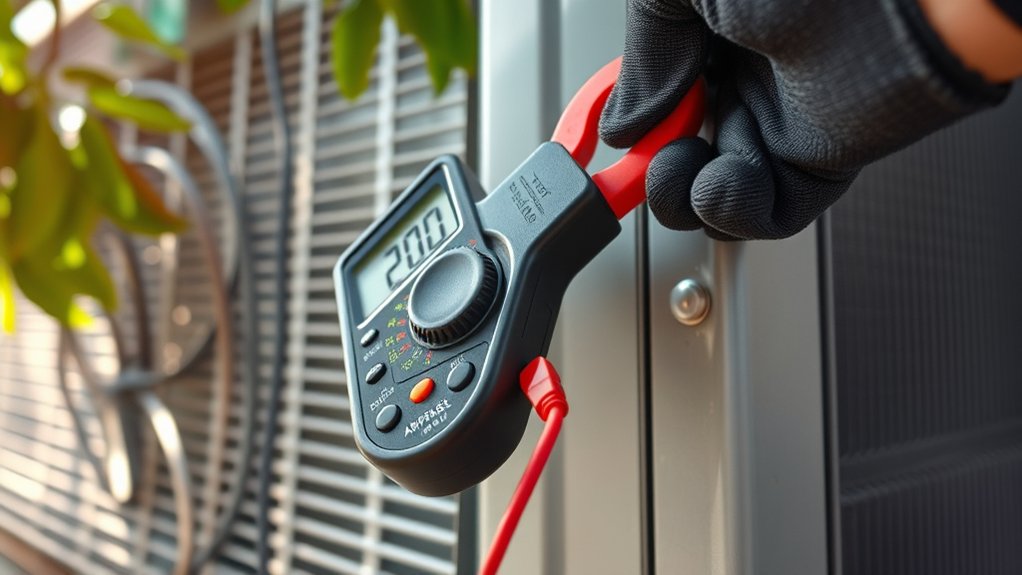
To measure your AC’s amperage safely, start by using a clamp meter that’s designed for your unit’s specific voltage and current range.
It’s really important to make sure the power is off before you attach the meter—this helps you avoid any electrical hazards.
When you’re reading the electrical panel, just be extra careful and follow all the proper safety steps.
This way, you can prevent any injuries or damage to your equipment.
Using a Clamp Meter
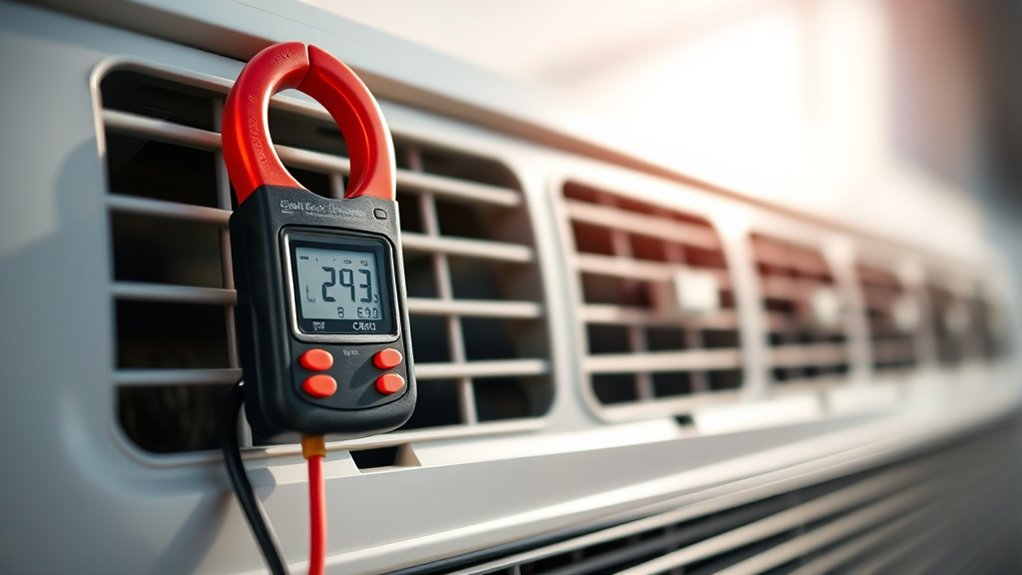
A clamp meter offers a safe and efficient way to measure your air conditioner’s amperage without disconnecting any wires. To use it, clamp the meter around the power supply wire supplying electrical current to the air conditioner. Make sure the clamp fully encircles the conductor for an accurate reading.
Select the AC amps setting on the meter to measure correctly. Take readings while the air conditioner is running under typical conditions because startup currents are higher and can skew the results.
For a thorough assessment of energy usage, try recording multiple readings at different times, including during peak load periods. Always use a clamp meter that’s rated for the current level you’re measuring.
And don’t forget to follow safety protocols, like wearing insulated gloves. This method gives you precise amperage data, which is really helpful for understanding your air conditioner’s electrical performance.
Ensuring Power Is Off
Measuring your air conditioner’s amperage with a clamp meter requires careful preparation to guarantee safety. Start by ensuring power is off. Switch off the circuit breaker supplying electricity to the air conditioner. This step prevents electric shock and damage while you measure amperage.
Next, inspect the electrical connections for security and damage. Loose or compromised wiring can distort readings and pose hazards. Use the clamp meter on the live wire only after confirming the power is off and connections are intact.
Consult your air conditioner’s specifications to know the expected amperage range. This helps interpret your measurements accurately.
If you’re uncertain about handling electrical components, hire a qualified electrician to safely measure and assess your air conditioner’s amperage.
Reading Electrical Panel Safely
Three key steps guarantee you read your electrical panel safely when measuring your air conditioner’s amperage.
First, always turn off the power to the AC unit at the circuit breaker to prevent electrical hazards.
Next, use a clamp meter designed for the expected amperage range. Typically, that’s 5 to 20 amps for residential units. This tool lets you measure amperage without disconnecting wires, making the process safer and more efficient.
Finally, when reading amperage, clamp the meter around only one wire, either hot or neutral, to get an accurate current measurement. Regularly monitoring amperage during peak usage helps detect electrical issues early. Unexpected increases can signal problems.
Following these steps guarantees you handle your electrical panel safely and get precise amperage readings with your clamp meter. It’s a simple way to keep things running smoothly and avoid surprises.
How to Calculate Your AC’s Amperage Using Watts and Volts
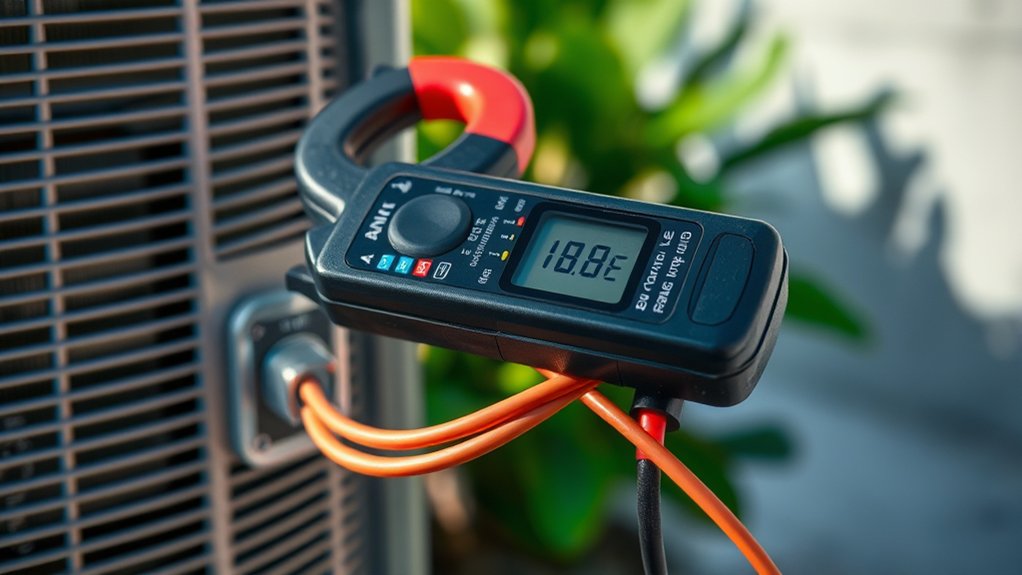
Calculating your air conditioner’s amperage requires dividing its wattage by the voltage it uses. This gives you a clear measure of electrical current flow. To calculate the amps your air conditioner draws, you’ll use the formula:
Amps = Watts ÷ Volts
For example, a 2,400-watt air conditioner running on 240 volts draws 10 amps.
When you calculate amperage, keep in mind a few important things.
Consider both running and starting amps because startup can draw 3 to 4 times more current. Always verify wattage and voltage from the manufacturer’s specs.
Accurate amps calculation helps prevent electrical overloads. Amperage also indicates compatibility with your home’s electrical system. Knowing amps guarantees proper circuit breaker sizing too.
This precise calculation lets you safely evaluate your air conditioner’s electrical demands.
Factors That Affect Air Conditioner Amperage Draw
You’ll notice that your air conditioner’s amperage draw varies quite a bit depending on its size.
Smaller units tend to use fewer amps, while larger ones naturally demand more.
Plus, it’s not just about size—operating conditions like the ambient temperature and humidity also play a role in how many amps your unit pulls during use.
Knowing these factors can really help you get a clear picture of your AC’s electrical needs.
Unit Size Impact
Air conditioner amperage draw varies considerably based on unit size, and this directly impacts the electrical load your system requires.
Smaller units, typically ranging from 5,000 to 8,000 BTU, use around 5 to 7 amps. Meanwhile, larger units between 14,000 and 25,000 BTU can draw 12 to 20 amps or more.
Central AC systems may demand 15 to 60 amps depending on capacity.
There are a few key factors influencing the amps air conditioners use. First, unit size measured in BTU determines the base amperage. Larger units require higher amps for adequate cooling.
Also, a higher voltage supply like 240V reduces amperage draw.
Keep in mind that starting amps can surge 3 to 4 times above running amps. Plus, higher energy efficiency (SEER rating) helps lower current consumption.
Understanding how unit size impacts amperage can help you optimize your electrical setup and energy use.
It’s worth paying attention to these details when choosing or upgrading your air conditioner.
Operating Conditions
Beyond the size and capacity of your air conditioner, several operating conditions directly affect its amperage draw. High outdoor temperatures force your unit to work harder, which increases amperage. Humidity levels also impact efficiency because higher moisture means more energy is used to remove it.
Older units often draw more amps than newer energy-efficient models due to wear and tear. Installing a programmable thermostat can help optimize performance by adjusting operation based on occupancy. This reduces the amperage draw and can save energy.
| Operating Condition | Effect on Amperage Draw |
|---|---|
| High Temperature | Increases amperage considerably |
| High Humidity Levels | Raises amperage due to moisture removal |
| Use of Programmable Thermostat | Lowers amperage by optimizing cycles |
Knowing these factors can really help you manage your AC’s energy consumption more effectively.
How AC Amps Affect Your Home’s Electrical Safety
When your air conditioner draws more amps than the circuit can handle, it risks tripping breakers or causing electrical fires. Confirming your AC’s amperage matches the circuit load is essential for electrical safety.
Most window units work with 15- or 20-amp circuits, but larger models need a dedicated outlet to prevent overloads.
You should also verify that the wiring gauge corresponds to the amps drawn. Regular maintenance helps detect wear or wiring issues that could increase risk.
Key points for maintaining electrical safety include:
- Verify the AC’s amperage rating before installation
- Use dedicated outlets for high-amp units
- Match wire gauge to the AC’s amps (e.g., 12/2 for 15 amps)
- Monitor circuit breakers for frequent trips
- Perform regular maintenance to check electrical connections and load
Understanding Energy Costs Based on AC Amperage and Wattage
Although understanding your AC’s amperage is important, grasping how it translates into energy costs means you need to consider both amps and voltage to figure out wattage. The formula Watts = Amps × Volts lets you calculate the exact electricity usage of your air conditioner.
For example, a central AC unit drawing 18 amps at 240 volts uses about 4,320 watts. Higher wattage means higher energy costs since your air conditioner is using more electricity. Air conditioners usually range between 5 to 20 amps, depending on their size and capacity.
So, knowing your unit’s amperage helps you estimate power consumption more accurately. Keeping an eye on amps and wattage not only helps you understand energy costs but also can alert you to efficiency problems.
If you notice rising amperage, it could mean your AC needs maintenance. Ignoring those signs might lead to even higher electricity usage and bigger operational expenses down the road.
Tips to Reduce Your Air Conditioner’s Amperage and Energy Use
Since your air conditioner’s amperage directly impacts energy consumption, implementing targeted strategies can considerably reduce electrical draw and lower operating costs. By optimizing your system’s efficiency, you minimize amperage draw and extend equipment lifespan.
Consider these technical tips:
Consider these technical tips to reduce your AC’s electrical draw and boost energy efficiency.
Clean or replace air filters every 1-2 months to improve airflow and reduce amperage draw by up to 15%.
Schedule annual maintenance to check refrigerant levels and guarantee steady amperage usage.
Use a programmable thermostat to adjust temperatures based on occupancy, reducing unnecessary energy consumption.
Seal leaks around windows and doors to maintain indoor cool air, which decreases the AC’s electrical load.
Upgrading to a high-efficiency AC model can also help because it requires less amperage and lowers overall energy consumption.
These steps let you take precise control over your AC’s electrical demands and boost energy efficiency.
It’s all about working smarter, not harder, when it comes to keeping cool.
When to Consult an HVAC Professional About AC Amperage and Electrical Requirements
If you’re selecting a new air conditioner or experiencing electrical issues like frequent circuit breaker trips, consulting an HVAC professional is essential to confirm your system meets your home’s amperage and voltage requirements.
An HVAC expert evaluates the amperage draw of your chosen AC unit to verify compatibility with your existing electrical circuits and overall electrical requirements.
If your current HVAC system trips breakers or shows erratic amperage use, professional help can diagnose wiring faults or overloads.
Before upgrading to a more powerful AC unit, consulting a professional assures your electrical circuits can accommodate increased amperage safely and comply with relevant codes.
Regular professional maintenance also helps detect amperage anomalies early, maintaining system efficiency and preventing electrical hazards.
Frequently Asked Questions
Can Amperage Affect the Lifespan of My Air Conditioner?
Yes, amperage directly affects your air conditioner’s lifespan. Excessive amperage increases compressor wear and reduces electrical efficiency. This causes power fluctuations that strain the components.
By monitoring amperage and sticking to proper maintenance practices, you can prevent premature damage and improve your system’s longevity. Regular inspections help catch amperage issues early. This makes sure your unit runs within its designed range.
Doing this minimizes costly repairs and boosts overall performance and durability. It’s a smart way to keep your air conditioner working well for years to come.
Do Inverter AC Units Use Less Amperage Than Traditional Ones?
You’ll find inverter AC units are gentler on amperage than traditional ones.
Thanks to inverter technology, they adjust compressor speed to optimize energy efficiency, reducing amperage draw considerably. This not only enhances cooling performance but also lowers noise levels and boosts cost savings over time.
By maintaining consistent operation, inverter units avoid power spikes typical in conventional systems.
This makes them a smarter, more economical choice for efficient cooling.
How Does Outdoor Temperature Influence My Ac’s Amperage Draw?
Outdoor temperature fluctuations directly affect your AC’s amperage draw by impacting cooling efficiency.
Higher temperatures increase power consumption as your unit works harder to maintain set indoor conditions.
Also, outdoor humidity can raise the electrical load since the system has to dehumidify the air.
Understanding your AC’s energy ratings helps you anticipate these changes.
By keeping an eye on both temperature and humidity, you can optimize your usage and manage your energy costs effectively.
It’s all about staying informed and adjusting as needed.
Is It Safe to Use an Extension Cord With My AC Unit?
Extension cord safety is seriously significant when using your air conditioner. You shouldn’t rely on power strip usage or flimsy cords, as appliance compatibility matters. Always check your air conditioner ratings to match or exceed the amp draw.
Keep extension cord length as short as possible to prevent voltage drop and overheating.
For ideal operation and safety, plug your AC directly into a wall outlet. This helps avoid risks associated with improper power sources.
Can Low Voltage Cause My AC to Draw Higher Amperage?
Yes, voltage fluctuations can cause your AC to draw higher amperage. When the power supply voltage drops, your unit compensates by increasing current, leading to amperage spikes. This reduces electrical efficiency and stresses components, risking circuit safety.
Consistently low voltage forces the compressor and motor to work harder, which can potentially overheat wiring or trip breakers.
To keep your AC running smoothly, it’s important to verify that your electrical system provides stable voltage. Also, keep an eye out for any irregular power supply conditions.
Conclusion
Understanding how many amps your air conditioner uses is essential for maintaining electrical safety and managing energy costs effectively. Like a car needing the right fuel to run smoothly, your AC requires the correct amperage to operate efficiently without tripping breakers or overloading circuits.
By measuring and calculating your unit’s amperage, you can optimize performance and know when to call a professional for help. This way, you ensure your system runs safely and economically.