Does Your Air Conditioner Use Gas?
Your standard air conditioner doesn’t use natural gas for power; it relies on electricity to run a refrigerant-based cooling cycle. The refrigerant absorbs indoor heat and releases it outside through evaporation and condensation, not combustion.
While some specialized systems use gas, they’re pretty rare and usually more complex. Knowing how your unit operates really helps with maintenance and efficiency.
If you’re curious about gas-powered options, costs, or system care, keep exploring to understand the details and distinctions.
Do Standard Air Conditioners Use Natural Gas for Power?
Although some home appliances run on natural gas, standard air conditioners don’t use natural gas for power. Air conditioning systems primarily rely on electricity as their energy source to operate compressors, blowers, and fans.
Unlike heating systems that burn gas as a fuel, air conditioners use refrigerants to transfer heat rather than combustion.
The confusion often comes from gas-powered appliances elsewhere in the home. Actually, the only gas involved in standard air conditioning is the refrigerant itself, which circulates within the system to absorb and release heat.
Using natural gas as a fuel for cooling is pretty rare and mostly limited to specialized equipment like absorption chillers.
Electric air conditioners usually offer lower operational costs and greater efficiency in residential settings, especially in places like Florida.
How Do Air Conditioners Cool Your Home?
Your air conditioner cools your home by moving refrigerant through a cycle of evaporation and condensation. This process helps transfer heat from inside your house to the outside.
Here’s how it works: the compressor pressurizes the refrigerant, turning it into a hot gas.
Then, this hot gas releases heat when it reaches the condenser. After that, the refrigerant expands and cools down in the evaporator coil.
This cycle keeps going, constantly pulling heat from indoors and blowing cool air into your rooms, so you stay comfortable all day long.
Refrigerant Cooling Cycle
When you turn on your air conditioner, it relies on a refrigerant cooling cycle that continuously transfers heat from inside your home to the outdoors. The refrigerant absorbs heat as it passes through the evaporator coil, changing from a liquid to a gas.
This gaseous refrigerant then moves to the compressor, where it’s pressurized and its temperature rises.
Next, the hot gas travels to the condenser, where it releases heat to the outside air and condenses back into a liquid.
After passing through an expansion valve, the refrigerant’s pressure drops, cooling it further before it returns to the evaporator coil to repeat the process.
This closed-loop cycle of evaporating and condensing refrigerant efficiently removes indoor heat, keeping your home comfortably cool.
Heat Transfer Process
Because air conditioners rely on a refrigerant to transfer heat, they effectively cool your home by moving indoor heat outside through a continuous cycle.
The heat transfer process begins as the compressor pressurizes the refrigerants, converting them into a hot gas. This gas travels to the condenser, where it releases heat and condenses into a liquid.
The liquid then passes through an expansion valve, lowering its pressure and temperature. At the evaporator coil, the refrigerant evaporates, absorbing heat from the indoor air. This absorption cools the air, which your system circulates back into your home.
Gas systems in air conditioners utilize this cycle efficiently, ensuring consistent cooling by continuously transferring heat from inside to outside through these precise thermodynamic steps.
It’s a smart process that keeps your home comfortable all year round.
What Role Does Refrigerant Play in AC Cooling?
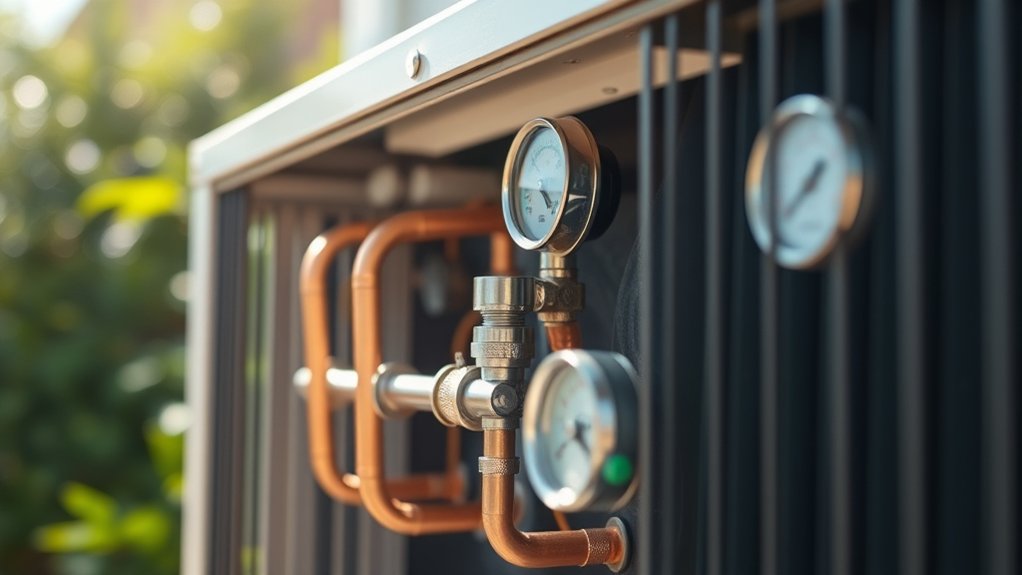
You know, refrigerant is pretty much the heart of your AC system. It works by absorbing heat from the air inside your home.
How? Well, it keeps switching back and forth between liquid and gas.
This change of state is what makes the heat transfer super efficient. Basically, the refrigerant pulls the warmth out of your indoor air and then releases it outside.
Getting how this process works is really helpful if you want to understand how your air conditioner keeps things cool and comfortable.
Refrigerant State Changes
Although refrigerant might seem like just another component in your air conditioner, it plays a critical role in the cooling process by undergoing state changes that enable heat transfer. The refrigerant absorbs heat from indoor air as a liquid and evaporates into a gas, facilitating cooling.
This gaseous refrigerant then moves to the condenser, where it releases stored heat and condenses back into a liquid, completing the cycle. Maintaining proper refrigerant levels guarantees peak energy efficiency and effective cooling performance.
Even minor leaks reduce the system’s ability to transfer heat efficiently, leading to higher energy consumption and decreased cooling capacity.
Advanced refrigerants like R-32 improve environmental impact without compromising system efficiency, emphasizing the importance of understanding refrigerant state changes in your AC’s operation.
Heat Absorption Process
Three key stages define the refrigerant’s role in the heat absorption process of your air conditioner.
First, the refrigerant absorbs heat from indoor air as it evaporates from liquid to gas within the evaporator coil.
Next, during the cooling cycle, the now-gaseous refrigerant carries this absorbed heat to the condenser outside.
Then, it releases the heat to the environment and condenses back into a liquid, ready to repeat the cycle.
This continuous phase change allows for efficient heat absorption and transfer without burning fuel.
Modern refrigerants, like hydrofluorocarbons (HFCs), optimize this process to maximize cooling efficiency while minimizing environmental impact.
Understanding this heat absorption process is essential for keeping your air conditioning system running smoothly and reducing its ecological footprint.
It’s a smart way to stay cool while being kind to the planet.
Why Do People Confuse Refrigerant Gas With Fuel Gas in AC Systems?
Why do so many people mix up refrigerant gas with fuel gas in air conditioning systems? The confusion comes mostly because both have the word “gas” in them, but they actually serve very different purposes.
Refrigerant gas works as a heat-transfer medium in the cooling cycle. It absorbs heat by changing from liquid to gas.
On the other hand, fuel gases like natural gas or propane are burned to create heat in heating appliances—not for cooling.
In air conditioning systems, refrigerants move around to pull heat out of indoor air. Fuel gases, meanwhile, provide energy for heating. So, they’ve a basic operational difference.
People often misinterpret terms like “gas-powered air conditioning” and think fuel gases directly power the cooling. But really, refrigerant gas is what makes the cooling happen, without any combustion involved.
Are There Any Air Conditioners That Run on Natural Gas?
Can air conditioners run on natural gas? Yes, gas-powered air conditioners do exist, though they’re rare compared to electric models.
Here’s what you should know about natural gas cooling options:
Gas-powered air conditioners utilize a thermally driven cycle, where natural gas heats refrigerant to transfer heat efficiently.
Certain HVAC systems, like absorption chillers and dual-fuel setups combining heat pumps with gas furnaces, operate on natural gas but are uncommon in Florida.
These systems can offer higher energy efficiency in regions with lower natural gas costs, providing an alternative to traditional electric cooling.
If you’re evaluating your HVAC systems, understanding how natural gas units work can help you make informed decisions about energy efficiency and cooling options tailored to your needs.
How Does Electricity Power Home Air Conditioners?
While natural gas-powered air conditioners offer an alternative cooling method, most homes rely on electricity to power their air conditioning systems.
Electricity drives key components such as the compressor, blowers, and fans, which are essential to the cooling cycle. The compressor pressurizes refrigerant, converting it into a hot gas that releases heat through the condenser before cooling and liquefying.
Electricity powers vital parts like the compressor and fans, enabling the cooling cycle by transforming refrigerant.
Electric air conditioning systems are considered 100% efficient in cooling since they don’t consume gas for this process. Maintaining your system by regularly cleaning coils and replacing filters optimizes energy efficiency and lowers electricity costs.
Upgrading to high-SEER models can improve energy efficiency by 30% to 50% compared to older units.
This makes electricity-powered systems both effective and economical for home cooling. It’s a smart choice if you want to keep your home comfortable without breaking the bank on energy bills.
What Are the Benefits and Drawbacks of Gas-Powered AC Systems?
Although gas-powered air conditioning systems are less common than electric ones, they offer distinct advantages and challenges that you should consider.
Gas-powered air conditioning can provide significant cost savings, especially in areas with lower natural gas prices. This can reduce your energy costs by 20% to 50%.
Furthermore, these systems have a smaller environmental footprint, emitting fewer greenhouse gases compared to electric units.
However, you must factor in maintenance needs, including annual inspections costing $150 to $300. These are important to guarantee safety and efficiency.
- Cost savings due to energy efficiency in suitable regions
- Reduced environmental footprint with lower emissions
- Increased maintenance needs and safety precautions, including gas leak vigilance
Balancing these factors will help you decide if a gas-powered AC fits your requirements. It really depends on your location and how much maintenance you’re willing to handle.
How Can You Tell If Your Air Conditioner Uses Gas or Electricity?
You can figure out what powers your air conditioner by looking at your energy bills.
Check if you have separate charges for gas and electricity—that’s usually a good clue.
Also, take a close look at the unit itself.
If you spot a gas line connected to it, then you know it’s gas-powered.
If you’re still not sure, just grab the user manual or check the specifications.
They’ll tell you whether your AC runs on electricity or gas.
Power Source Identification
How can you determine whether your air conditioner runs on gas or electricity? First, identify the power source by inspecting the unit. Here’s how:
- Check for a gas meter or gas line: If your system has these connected, it likely uses gas. Electric units don’t require them.
- Determine if it’s a dual-fuel system: These systems combine gas for heating and electricity for cooling. They often involve a heat pump.
- Review model specifications or manufacturer’s documentation: These details explicitly state whether the system runs on gas or electricity.
They also identify the refrigerant type.
Visual System Indicators
Where should you look to visually distinguish whether your air conditioner uses gas or electricity? Start by inspecting the unit’s connections for a gas meter or natural gas lines. Their presence confirms gas is involved as the fuel source.
If you don’t see these, it usually means the system runs on electricity. You can also check for visual system indicators such as gas burners or exhaust vents. These are common in gas-powered air conditioners but rare in most residential setups.
Another good idea is to review the unit’s specifications or user manual, which can clarify the fuel source. Sometimes, your system might combine both electric and gas components. This is called a dual-fuel system, designed to optimize efficiency.
Understanding these visual cues helps you select the right system for your needs. Plus, it guarantees proper maintenance of your air conditioner.
Checking Energy Bills
Visual inspection gives you quick clues about whether your air conditioner uses gas or electricity. But checking your energy bills can give you a clear answer. When looking at your bills, focus on your utility statement to spot the power source for your AC system.
Here’s how you can do it: First, check the line items for electric and gas charges. If your bill is electric-only, it usually means your AC runs on electricity.
Next, look at energy use during the hottest months. If electric consumption spikes but there are no gas charges, that confirms your AC is electric.
If your bill shows both electric and gas charges, your AC might be electric while gas powers your heating. Most central air units use electricity.
But if you want to be 100% sure, check your HVAC specs or ask a technician.
What Are the Key Maintenance Differences Between Gas and Electric AC Systems?
Why do gas and electric air conditioning systems demand different maintenance approaches?
Gas systems require regular checks for gas leaks and carbon monoxide detectors to guarantee safety. Electric systems, on the other hand, focus more on electrical component upkeep.
Gas systems need gas leak and carbon monoxide checks, while electric systems prioritize electrical component maintenance.
You’ll notice that gas systems need more frequent professional inspections to maintain efficiency and safety. Electric systems typically require annual tune-ups.
Maintenance costs range between $150-$300 per visit for both, but gas systems may incur extra expenses for ventilation and safety checks.
Filter replacement intervals are similar, with both systems demanding checks every 1-3 months to optimize airflow.
Plus, while both need debris cleared from outdoor units, gas systems require attention to the combustion area to sustain efficient operation and prevent hazards.
When Should You Call a Pro for AC Refrigerant or Gas System Problems?
If your air conditioner shows signs like unusual noises, freezing compressor coils, or reduced cooling efficiency, you should call a professional immediately. Addressing AC gas and refrigerant issues promptly prevents system damage and rising energy bills.
Here are key instances to seek professional repair:
- Detecting low refrigerant levels or leaks requires an HVAC technician to restore peak function and prevent compressor damage.
- Hearing loud noises or vibrations indicates potential compressor or component failure needing expert diagnosis.
- Experiencing frozen compressor coils or insufficient cooling demands immediate evaluation to avoid costly breakdowns.
Regular maintenance by a qualified HVAC technician also helps identify refrigerant or gas system problems early.
This way, your AC operates efficiently and safely. Don’t delay professional repair when these critical symptoms appear.
Frequently Asked Questions
Can Gas-Powered Air Conditioners Work During Power Outages?
Yes, gas-powered air conditioners can work during power outages if they’re designed to operate independently of electricity. Their gas efficiency often surpasses electric units, but installation costs tend to be higher.
For peak performance, focus on maintenance tips like checking gas lines and ventilation. These steps help keep your system running smoothly when you need it most.
Environmentally, gas-powered units emit less CO2 than electric systems that rely on fossil-fuel-generated electricity.
When you compare performance, gas units provide reliable cooling without depending on the grid. This makes them ideal for areas where power outages happen frequently.
How Safe Are Natural Gas Air Conditioners Compared to Electric Ones?
Think of natural gas air conditioners like a finely tuned engine. They deliver strong energy efficiency and cost savings but also come with some important safety concerns.
Compared to electric units, they pose risks like gas leaks and carbon monoxide. That means they need strict maintenance and proper ventilation to keep things safe.
Electric units tend to have a cleaner environmental impact and fewer safety issues. But if natural gas models are well-maintained, they can still be cost-effective.
You just have to stay on top of upkeep to make sure they operate safely. So, while natural gas units save money, they require a bit more attention than electric ones.
Do Gas Air Conditioners Require Different Installation Procedures?
Yes, gas air conditioners require different installation procedures.
You’ll need specialized installation techniques including proper gas line requirements to safely supply fuel.
Ductwork considerations guarantee efficient airflow and system compatibility.
Ventilation needs are critical to prevent hazardous buildup, so exhaust systems must be correctly installed.
Furthermore, safety inspections are mandatory to verify leak prevention and compliance with regulations.
This makes professional installation essential for reliable and secure operation.
What Is the Average Lifespan of a Gas-Powered Air Conditioner?
Think of your gas-powered air conditioner like a car. It lasts about 15 to 20 years with proper care.
Regular maintenance, like cleaning filters and checking the compressor, really helps boost energy efficiency and performance.
Also, factor in environmental impact and cost analysis when deciding on upgrades. Newer models usually offer better performance and can reduce your expenses.
Staying proactive means your system runs smoothly and lasts longer.
Are Gas Air Conditioners Compatible With Smart Home Systems?
Yes, gas air conditioners often support smart thermostat integration, allowing you to optimize energy efficiency ratings by learning your habits.
You can access remote control options via mobile apps, which makes things way more convenient.
However, installation costs might be higher because of compatibility checks and any necessary upgrades.
Maintenance requirements stay pretty standard but can be monitored remotely with some smart systems. This helps you schedule timely service and boost overall system performance.
Just make sure to verify your model’s smart home compatibility before making any decisions.
Conclusion
So, does your air conditioner use gas? Most standard AC units run on electricity, not natural gas. They rely on refrigerants to cool your home effectively.
While gas-powered AC systems do exist, they’re less common and come with different maintenance needs. Knowing how your system works helps you spot issues early.
Isn’t it worth understanding your AC’s power source to guarantee peak performance and timely professional care?