
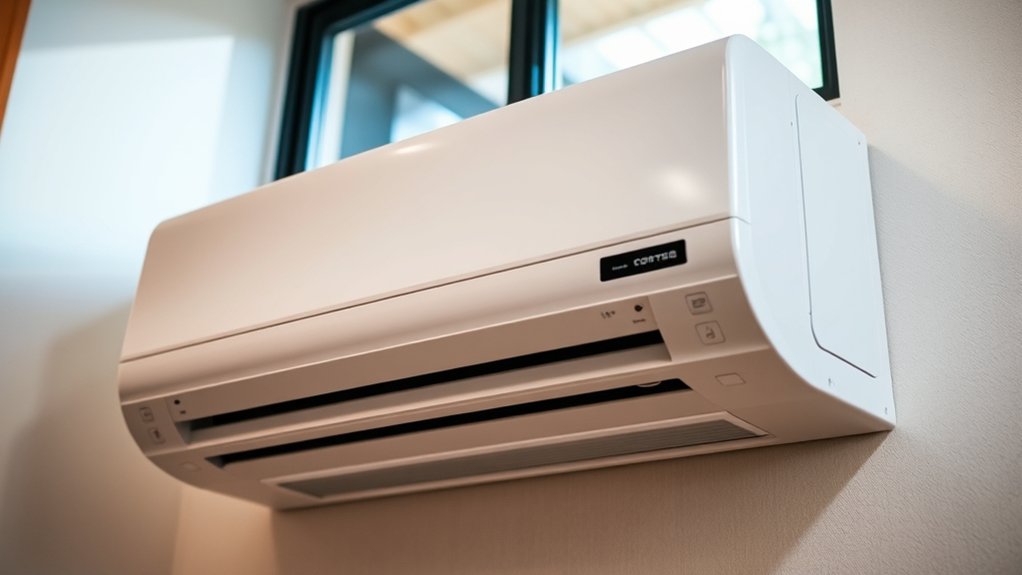
What Is a Packaged Terminal Air Conditioner?
A Packaged Terminal Air Conditioner (PTAC) is a self-contained, wall-mounted unit designed to provide precise heating and cooling for individual rooms. You’ll find them in hotels, hospitals, and apartments. They offer adjustable temperature control without ductwork.
PTACs deliver efficient airflow, typically between 200 and 1200 cfm, with capacities from 7,000 to 19,000 BTU/h. They’re easy to maintain and energy-efficient. Often, they feature heat pumps and advanced compressors.
If you dig a little deeper, you’ll see how PTACs balance performance and convenience in different settings. They really are a smart choice for varied applications.
What Is a Packaged Terminal Air Conditioner (PTAC)?
You’ll find PTACs delivering targeted climate control with capacities from 7,000 to 19,000 BTU/h. They’re ideal for individual rooms in hotels, hospitals, and apartments.
PTAC units provide precise climate control from 7,000 to 19,000 BTU/h, perfect for hotels, hospitals, and apartments.
This unit’s design allows you to independently regulate temperature in each space efficiently. Modern PTACs often include energy-efficient compressors and optional heat pumps, which help reduce airflow loss and lower utility costs.
Their wall-mounted configuration makes maintenance easier. You can easily access filters for cleaning or replacement.
When you use a PTAC, you benefit from precise heating and cooling control tailored to specific room requirements. It’s a practical solution in both commercial and residential environments alike.
How PTACs Are Installed and Where They Fit Best
Installing a PTAC unit involves mounting it directly through an exterior wall. This means you’ll need to create an opening that’s just the right size and reinforce it for stability.
Standard openings usually fit PTAC units measuring about 42×16, 40×15, or 36×15 inches. These sizes make it easy to install the unit under windows or within masonry walls. Proper installation ensures you get maximum airflow and a secure fit. Components like metal sleeves and louvers really help with this.
PTAC units work best in a few specific places. For example, hotels and hospitals use them for individual room climate control. They’re also great for buildings that need compact, wall-mounted cooling and heating options.
You’ll find them handy in spots where easy maintenance access is important. Plus, they fit well in spaces that need minimal disruption to the existing architecture.
If you follow the installation guidelines carefully, your PTAC units will run efficiently and last a long time.
Key Components Inside a PTAC Unit
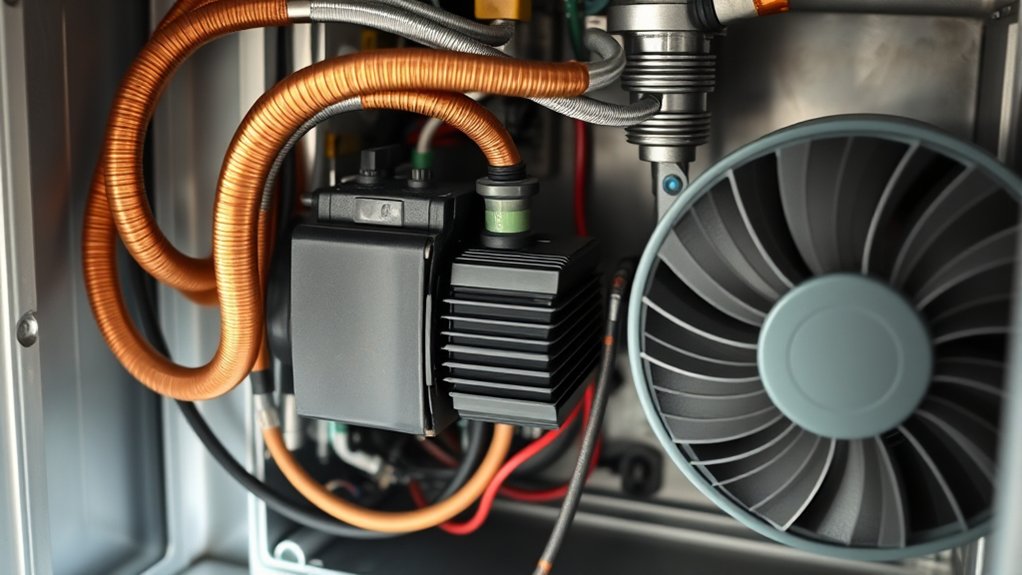
Inside a PTAC unit, you’ll find some key components working together to keep the temperature just right.
There’s the outdoor air mixer, which brings in fresh air from outside. Then, you’ve got the DX cooling coil that helps cool things down when it gets too warm. Alongside that, the heating coil kicks in to warm the air when needed.
Don’t forget the supply air fan—it plays a big role in moving the air through the system.
Depending on the design, this fan can be set up in either a blow-through or draw-through configuration.
Getting to know these parts gives you a clear picture of how PTAC units provide reliable climate control.
Core Functional Components
Efficient climate control in a PTAC unit relies on several core components working in unison. As you explore a packaged terminal air conditioner, you’ll find these elements essential for managing indoor temperature and comfort.
- Outdoor Air Mixer: Regulates the intake of fresh air, maintaining air quality.
- DX Cooling Coil: Provides direct expansion cooling to remove heat efficiently.
- Heating Coil: Offers heating via hydronic, electric resistance, or natural gas options for versatile warmth.
- Supply Air Fan: Moves conditioned air into the room, optimizing airflow without compromising performance.
Each component is designed to balance cooling and heating capacities, typically ranging from 7,000 to 19,000 BTU/h. This ensures the PTAC adapts to various room sizes and climate demands.
Understanding these parts helps you appreciate the unit’s precise climate control capabilities.
It’s pretty interesting how all these elements work together, isn’t it?
Fan Configuration Options
The performance of a PTAC unit heavily depends on how the supply fan is configured and operates. In PTAC systems, you’ll find two main fan placements: “Blow Through,” where the fan sits before the coils, and “Draw Through,” where it follows them.
Fan speed control typically involves either a “Cycling Fan” mode, which matches the system’s heating or cooling cycles, or a “Continuous Fan” mode that runs regardless of demand.
Most PTAC units use a “Constant Volume” fan to maintain steady airflow, although some models offer “Variable Volume” options.
The fan’s pressure rise usually defaults to about 4 inches H2O, operating between 0.25 and 5 inches H2O.
Energy consumption varies with a Fan Full Load Energy Rate between 0.0001 and 0.0004 kW/(cfm), which influences efficiency and costs.
Heating and Cooling Capacities Explained
You’ll find PTAC units offer cooling capacities ranging from about 7,000 to 19,000 BTU per hour.
These are measured in both BTU/h and kilowatts to give you an accurate idea of their power.
When it comes to heating, there are options like electric resistance and hydronic coils, so you can pick what works best for your environment.
Knowing these capacity details really helps you choose the right unit for your space and climate control needs.
Cooling Capacity Range
Packaged Terminal Air Conditioners (PTACs) offer cooling capacities ranging from 7,000 to 19,000 BTU/h. This range lets you pick a unit that fits different room sizes and cooling needs.
Whether you’re cooling a small office or a larger suite, this capacity ensures efficient temperature control.
When choosing a PTAC, think about matching the cooling capacity to the room’s square footage for the best performance. It’s also smart to select units with adjustable capacities so you have flexibility during installation.
Make sure the airflow rate, which can be between 200 to 1200 cfm, matches what your space requires.
Also, check that the PTAC’s nominal cooling capacity meets or exceeds the calculated cooling load.
Knowing these details will help you get the most energy efficiency and keep your space comfortable with the right PTAC cooling capacity.
Heating Options Available
After selecting a PTAC based on cooling capacity, understanding the available heating options is just as important for thorough climate control.
PTAC units typically provide heating capacities between 7,000 and 19,000 BTU/h, which can accommodate different space requirements.
You can choose between resistance heating or packaged terminal heat pumps. Both offer efficient and versatile heating solutions.
Resistance heating coils may operate on electricity, hydronic systems, or natural gas, so you can customize them to fit your building’s infrastructure.
Packaged terminal heat pumps combine heating and cooling functions, optimizing energy use for year-round comfort.
By managing heating in individual spaces, these PTAC units can reduce energy consumption compared to centralized systems.
This flexibility makes PTACs ideal for commercial and multifamily applications where precise temperature control really matters.
Capacity Measurement Units
When sizing a PTAC unit, understanding capacity measurement units is essential for matching heating and cooling loads accurately. PTAC capacities are typically expressed in MBh (thousand BTU per hour), ranging from 7 to 19 MBh (7,000 to 19,000 BTU/h), equivalent to 2 to 5.5 kW. Knowing these units helps you select the right unit for your space, optimizing energy efficiency.
Key factors include cooling and heating capacities measured in BTUh or kW, and airflow rates typically between 200 to 1200 cfm, which affect performance.
There are also options for hydronic or natural gas heating to suit your needs.
Energy ratings come in kW, BTUh, and tons, helping you evaluate efficiency. Understanding these capacity measurement units guarantees precise load matching and enhances overall system energy efficiency.
It’s all about choosing the right fit for your space so you get the best performance.
How PTACs Deliver Individual Room Temperature Control
Because PTAC units operate as self-contained systems installed directly through exterior walls, they eliminate the need for ductwork and provide precise, individual room temperature control for each room.
You can manage heating and cooling within spaces of 200-300 square feet using PTACs with capacities ranging from 7,000 to 19,000 BTU/h.
This design lets you set different temperature preferences independently in multiple rooms, which is ideal for places like hotels or apartments. Many models come with remote thermostat control, so you can adjust settings conveniently without getting up.
Set individual room temperatures independently, perfect for hotels and apartments, with convenient remote thermostat control.
Plus, modern PTACs include energy-efficient compressors and optional heat pumps that optimize performance while cutting down on energy use.
Advantages of PTACs for Commercial and Residential Use
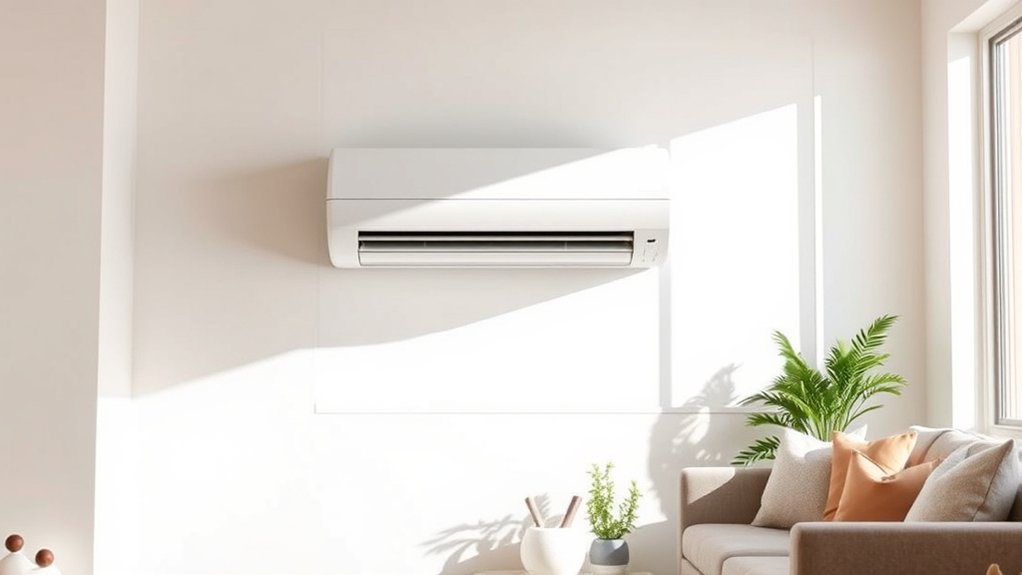
Although you might consider centralized HVAC systems for large buildings, PTAC units offer some pretty significant advantages for both commercial and residential use. Their cooling capacity ranges from 7,000 to 19,000 BTU/h, which lets you control the temperature of individual rooms efficiently.
PTACs have a wall-mounted, compact design that gets rid of the need for ductwork. That makes installation and maintenance way more straightforward.
Here are some key advantages:
- They run energy-efficiently thanks to advanced compressors and optional heat pumps, which helps cut down on utility costs.
- They work all year round, providing both cooling and heating—perfect for places with changing climates.
- The filters are easy to access for maintenance, which keeps the air quality good and the unit running smoothly.
- Plus, they operate with minimal noise, so they won’t disturb your comfort whether you’re at home or at work.
PTACs vs. Ductless Mini-Splits: Which One’s Right for You?
While PTAC units offer practical benefits for individual room climate control, you might be weighing them against ductless mini-split systems to determine which best suits your needs. PTACs are self-contained, wall-mounted units requiring larger wall openings and typically have a bulkier footprint.
In contrast, ductless mini-splits feature an outdoor condenser with multiple indoor air handlers connected by copper lines, allowing flexible placement with smaller installation requirements. Mini-splits generally operate quieter and deliver higher SEER ratings, enhancing comfort and efficiency.
However, PTACs often comply better with commercial building ventilation codes, making them common in hotels and commercial properties.
For residential settings prioritizing noise reduction and versatility, ductless mini-splits might be preferable. Your choice hinges on installation constraints, noise sensitivity, and whether you’re outfitting a commercial or residential space.
Energy Efficiency in Modern PTACs
You’ll find that modern PTACs come with advanced compressors designed to optimize energy use while still keeping performance high.
Plus, many models now use eco-friendly refrigerants, which help reduce environmental impact without cutting down on efficiency.
Knowing about these features can really help you pick a unit that strikes a good balance between saving energy and being sustainable.
Advanced Compressor Technology
A key factor driving energy efficiency in modern Packaged Terminal Air Conditioners (PTACs) is their advanced compressor technology. This technology optimizes performance while reducing energy consumption, helping you save on utility bills.
Modern PTAC compressors often incorporate features that precisely adjust to cooling or heating demands, enhancing comfort and lowering power use.
Here’s how advanced compressor technology improves energy efficiency:
- Variable-speed compressors modulate output based on real-time needs, avoiding unnecessary energy use.
- Reduced airflow loss through ductwork minimizes wasted energy.
- Higher Seasonal Energy Efficiency Ratio (SEER) ratings guarantee superior performance compared to older models.
- Integration with heat pump systems delivers efficient year-round climate control.
Pretty cool, right? These improvements mean you get better comfort while using less electricity. It’s a win-win!
Eco-Friendly Refrigerants
Since refrigerants play a critical role in PTAC performance, choosing eco-friendly options markedly reduces greenhouse gas emissions and environmental impact.
Modern PTAC units use eco-friendly refrigerants that comply with strict U.S. Department of Energy regulations. This means less ozone depletion and a lower global warming potential.
These refrigerants work smoothly with advanced compressors and heat pump technology, optimizing energy efficiency in both cooling and heating modes.
By minimizing airflow loss and electricity consumption, PTACs with eco-friendly refrigerants boost overall system performance and cut operational costs.
When you pick a PTAC with these refrigerants, you’re investing in a sustainable HVAC solution that meets regulatory standards and environmental responsibility.
Plus, you don’t have to sacrifice comfort or efficiency.
PTAC Installation and Maintenance: What to Expect
Although installing a PTAC unit requires creating a large opening through an exterior wall, the process is streamlined by standardized wall sleeves and specific components like louvers and metal sleeves that guarantee a secure, functional fit.
This design simplifies PTAC installation without major HVAC modifications.
For maintenance, expect user-friendly access to filters, enabling easy cleaning or replacement to keep your unit running effectively. Newer models operate quietly, enhancing comfort.
Key points to expect during PTAC installation and maintenance:
- Precise wall sleeve alignment guarantees weatherproof sealing
- Louvers facilitate proper airflow
- Accessible filters promote straightforward upkeep
- Independent servicing of each unit supports longevity
Regular maintenance is essential to maintain peak performance and prolong your PTAC’s lifespan.
It really helps keep your unit running smoothly for years to come.
PTAC Certification and Quality Standards Explained
Three key certification standards govern Packaged Terminal Air Conditioners (PTACs), guaranteeing they deliver reliable performance, energy efficiency, and compliance with ventilation codes. The ANSI/AHRI 310/380-2017 standard mandates rigorous testing of PTAC units’ heating and cooling capacities, ranging from 7,000 to 19,000 BTU/h.
Three key standards ensure PTACs provide reliable performance, energy efficiency, and ventilation compliance.
Furthermore, all certified PTACs must comply with U.S. Department of Energy regulations (10 CFR 431.92), assuring peak energy efficiency. This certification program provides documented verification of product performance and adherence to ventilation requirements, simplifying code compliance.
You’ll also benefit from the General Operations Manual’s regular updates, which offer essential guidance to maintain certification and promote ongoing efficiency and ease of use.
Ultimately, these standards protect your investment by confirming that PTAC units meet strict quality and operational benchmarks.
Frequently Asked Questions
Can PTAC Units Connect to Smart Home Systems?
Yes, many PTAC units support smart home integration, allowing you to connect them with your smart devices via RF links or Wi-Fi.
This connection lets you remotely control and monitor temperature settings, improving energy efficiency by automating schedules based on occupancy.
You can also receive real-time maintenance alerts, like filter replacements.
Using voice commands or apps, you’ll enhance comfort while reducing energy waste through precise, convenient management of your PTAC unit.
It’s a great way to make your space smarter and more comfortable.
What Is the Average Lifespan of a PTAC Unit?
The average lifespan of a PTAC unit ranges from 10 to 15 years. You can extend this by prioritizing PTAC maintenance, such as regularly cleaning filters and checking refrigerant levels.
Environmental factors and usage intensity also affect longevity.
Upgrading to energy-efficient models not only boosts performance but can also lengthen your unit’s service life.
Staying proactive with maintenance and embracing energy efficiency guarantees your PTAC operates reliably over time.
Are PTAC Units Noisy During Operation?
Like a quiet hum in the background, PTAC units typically operate at noise levels around 50 to 60 decibels, similar to a refrigerator’s gentle buzz.
You won’t find them disruptive if you keep their filters clean and maintain operational efficiency.
Newer models use advanced compressors and better insulation, reducing noise further.
Can PTAC Units Be Used in Humid Climates?
Yes, you can use PTAC units in humid climates because they offer effective humidity control alongside cooling.
Modern PTACs feature advanced compressors and moisture management, which enhances energy efficiency while keeping indoor air quality comfortable.
To get the best performance, make sure the unit is installed properly with adequate drainage.
Also, regular maintenance is key—clean the filters and check the drains often. This helps prevent water buildup and lets the unit manage humidity much more efficiently.
What Are Common Troubleshooting Tips for PTAC Units?
If your PTAC unit shows temperature fluctuations or noisy operation, start by checking for a clogged filter or a faulty thermostat.
Also, take a look for refrigerant leaks and any electrical issues like power supply stability and tripped breakers.
Improper installation can cause performance problems too, so it’s a good idea to verify the mounting and sealing.
By addressing these factors, you’ll ensure efficient operation and prevent damage.
This way, you can troubleshoot common PTAC issues accurately and effectively.
Conclusion
When you choose a PTAC, you get precise control, easy installation, and reliable heating and cooling all in one compact unit. PTACs fit perfectly where space is tight, deliver efficient performance, and require straightforward maintenance.
Whether you compare them to ductless mini-splits or consider energy standards, PTACs consistently meet quality and certification criteria. So, when you want efficiency, convenience, and control working seamlessly together, a PTAC is the solution you need.