How Does a Window Air Conditioner Work Step by Step
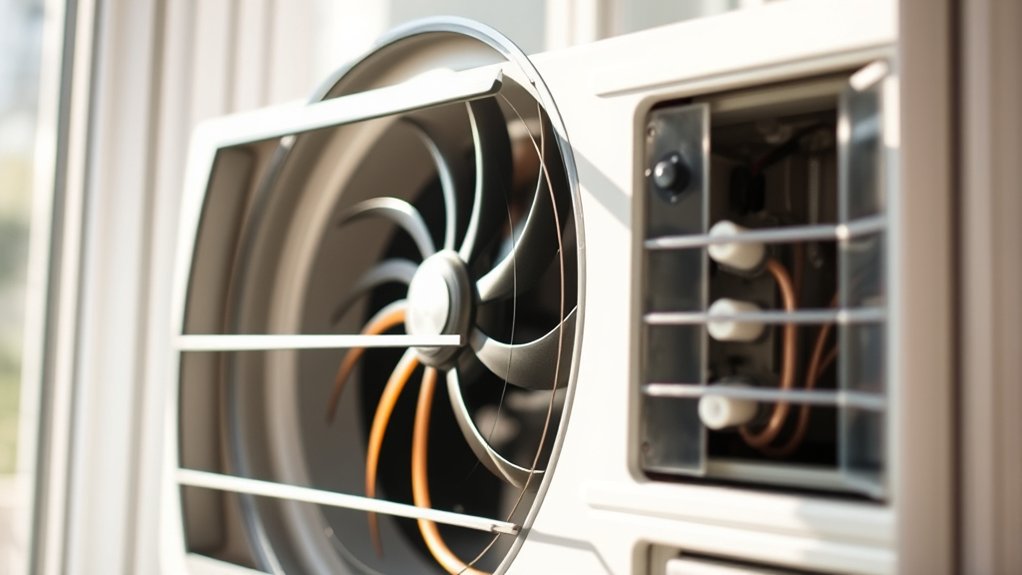
A window air conditioner works by drawing warm indoor air over cold evaporator coils filled with refrigerant. This refrigerant absorbs heat and changes from liquid to gas, cooling the air you feel.
The compressor then raises the refrigerant’s pressure and temperature, sending it to the condenser coil outside. There, it releases heat and turns back to liquid. Fans help move air efficiently throughout the unit.
The thermostat controls the cooling cycle to keep things comfortable. Keep going to understand the roles of key components and maintenance tips.
How a Window Air Conditioner Removes Heat
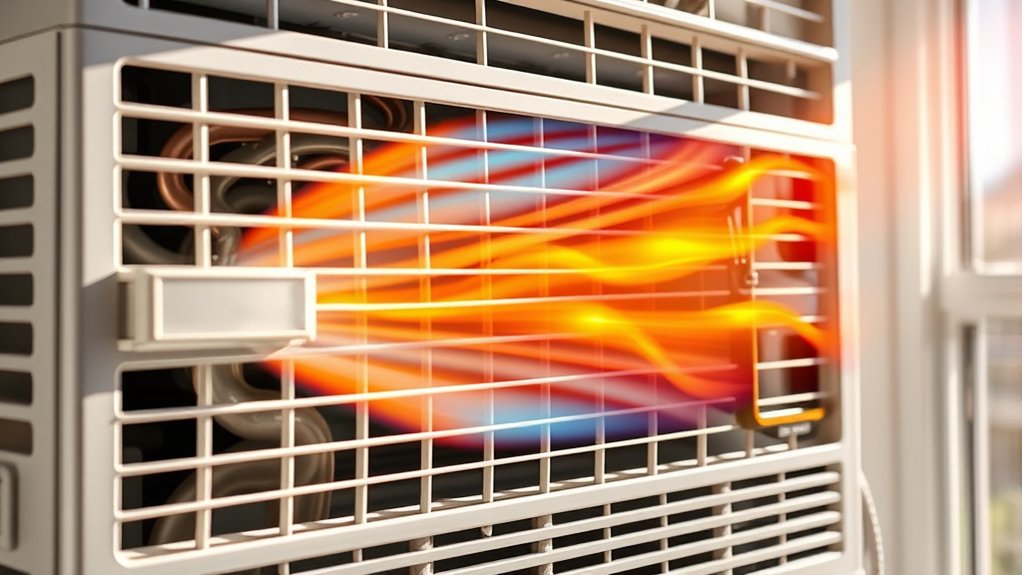
A window air conditioner removes heat by drawing warm indoor air over cold evaporator coils filled with refrigerant, which absorbs the heat. As the air passes over the evaporator coils, the refrigerant inside changes phase, effectively capturing heat from the air. This process lowers the air temperature, enabling the cooling effect.
Moisture in the air condenses on the cold coils and drains away, reducing humidity. The refrigerant, now carrying the absorbed heat, is cycled out of the evaporator coils to continue the cooling loop.
How Refrigerant Cools Your Room
Two key phases of the refrigerant cycle enable your window air conditioner to cool your room effectively.
First, the refrigerant absorbs heat as it evaporates in the evaporator coil inside your room. This phase cools the air that’s blown back into your space, reducing the indoor temperature.
Then, the refrigerant moves to the condenser coil outside, where it releases the heat absorbed from inside and converts back to liquid form.
Here’s how this cooling process works:
- The refrigerant absorbs heat in the evaporator coil, turning from liquid to gas.
- Cooling air passes over the evaporator coil, lowering room temperature.
- The refrigerant releases heat at the condenser coil, returning to liquid.
This continuous cycle keeps your room comfortably cool.
How the Compressor and Expansion Valve Work Together
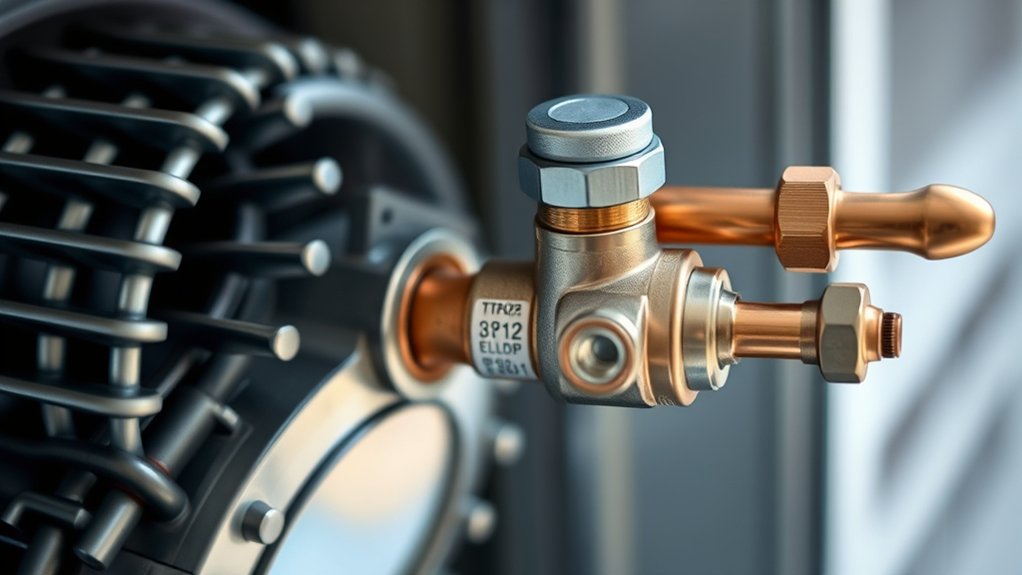
You’ll notice the compressor works by compressing refrigerant gas, which raises its pressure and temperature.
After that, it sends the gas to the condenser coil.
Then, the expansion valve steps in and quickly reduces the refrigerant’s pressure.
This drop in pressure cools the refrigerant as it heads toward the evaporator coil.
Together, these two parts keep the refrigerant flowing in a continuous cycle, making sure heat transfer happens efficiently for cooling.
Compressor Role Explained
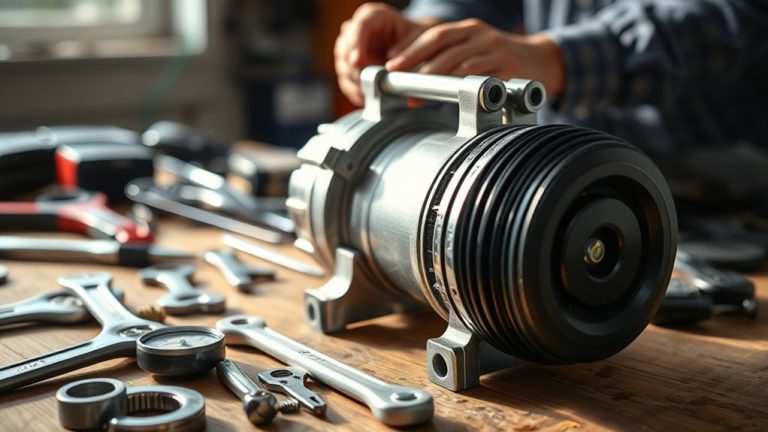
Although often overlooked, the compressor plays an essential role in your window air conditioner by compressing refrigerant gas to increase its pressure and temperature before directing it to the expansion valve. This step is critical for maintaining the cooling cycle efficiently.
Here’s how the compressor impacts the system:
- It raises refrigerant pressure and temperature, enabling heat release in the condenser coil.
- It guarantees the refrigerant reaches the evaporator coil at the right state to absorb indoor heat effectively.
- It operates intermittently, cycling on and off based on pressure levels, enhancing energy efficiency.
Expansion Valve Function
Following the compressor’s work of increasing refrigerant pressure and temperature, the expansion valve takes over to regulate the refrigerant flow into the evaporator coil. This valve precisely meters the high-pressure liquid refrigerant, causing a sharp drop in pressure as it enters the evaporator coil.
This pressure reduction allows the refrigerant to expand and evaporate, transforming from liquid to gas while absorbing heat from the indoor air.
The resulting low-pressure, cool refrigerant fuels effective heat exchange within the evaporator coil. The compressor and expansion valve work in tandem to maintain proper refrigerant pressure levels throughout the system, ensuring efficient cycling between high and low pressure.
This coordinated interaction is essential for transforming the refrigerant’s state, enabling the window air conditioner to cool your indoor environment effectively.
Coordinated Cooling Cycle
Because the compressor and expansion valve operate in a continuous loop, they work together to regulate refrigerant pressure and temperature, driving the cooling process inside your window air conditioner.
The compressor compresses the refrigerant into a high-pressure liquid, releasing heat at the outdoor condenser coil.
Then, the expansion valve causes a pressure drop, enabling the refrigerant to evaporate and cool considerably. This cooled refrigerant passes through the evaporator coil, absorbing heat from the indoor air and lowering the room temperature.
This coordinated cooling cycle depends on a few key steps:
- The compressor raising refrigerant pressure and temperature.
- The expansion valve reducing pressure to cool the refrigerant.
- The evaporator coil facilitating heat transfer from indoor air.
Together, these steps maintain efficient cooling by leveraging refrigerant phase changes and heat transfer.
It’s a smart system working quietly to keep your space comfortable.
What Happens at the Evaporator Coil Inside Your Room
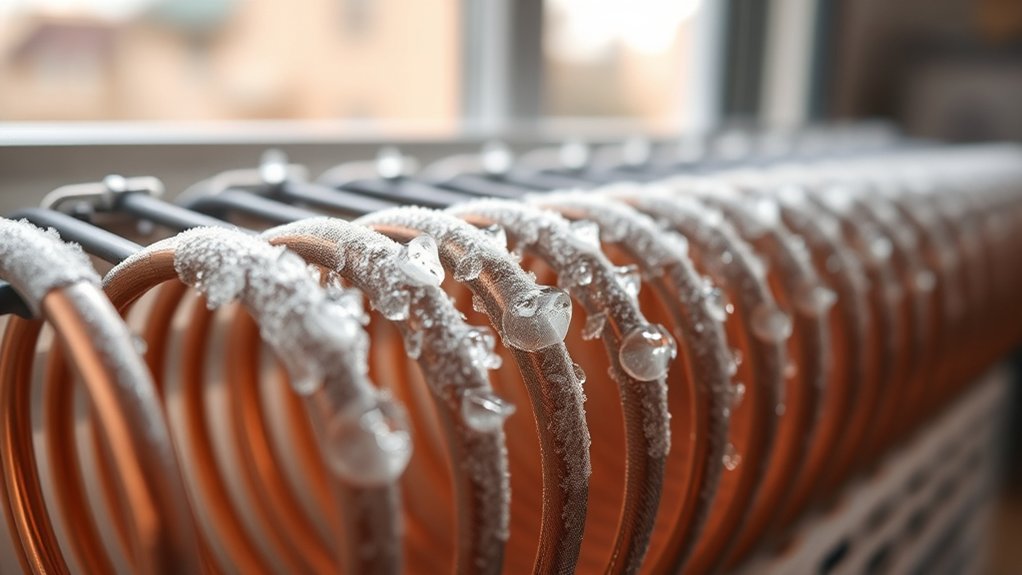
When warm indoor air passes over the cold evaporator coil inside your room, heat transfers from the air to the refrigerant circulating within the coil. This heat absorption causes the refrigerant to evaporate from a liquid to a gas, effectively lowering the air temperature. The evaporator coil, typically maintained between 40°F and 50°F, maximizes this cooling effect.
As the warm air cools, moisture in it condenses on the coil’s surface, reducing indoor humidity. This condensate collects in a drain pan and is expelled outside, further enhancing comfort.
Proper function and maintenance of the evaporator coil are essential. Any dirt or blockage can impair heat transfer, diminishing the unit’s efficiency and reducing its ability to cool your room effectively.
How the Condenser Coil Releases Heat Outside
You’ll find the condenser coil outside your window unit. It’s the part that releases the heat absorbed from inside your home.
As the high-pressure refrigerant moves through the coil, it passes heat to the outdoor air.
At the same time, a fan helps boost airflow, which speeds up the cooling process.
Because of this heat release, the refrigerant changes from a gas back into a liquid, getting ready to cycle back inside again.
Heat Transfer Mechanism
Although the condenser coil operates outside your living space, it plays an essential role in expelling the heat that the air conditioner absorbs indoors. The heat transfer mechanism relies on the refrigerant entering the condenser coils as a high-pressure gas after compression.
Here’s how it works:
- The refrigerant releases heat to the outdoor air as it flows through the condenser coils, shifting from gas to liquid.
- This phase change is critical to complete the cooling cycle, allowing the refrigerant to return to the evaporator coil for further heat absorption indoors.
- Efficient heat transfer in the condenser coils guarantees the system maintains a consistent cooling cycle, keeping your indoor air comfortable.
Understanding this process clarifies how the condenser coil sustains the air conditioner’s overall function.
It’s pretty neat how all these steps work together to keep your home cool and comfortable!
Role of Condenser Fan
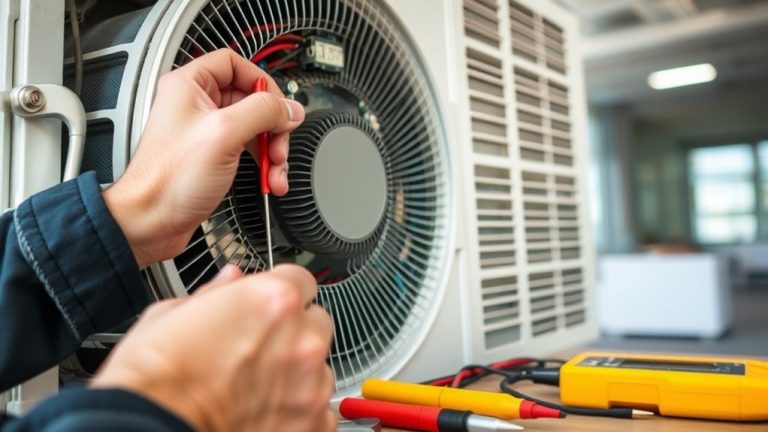
The condenser coil depends on the condenser fan to release heat effectively to the outside environment. The condenser fan draws outside air across the condenser coil, promoting efficient heat dissipation by facilitating optimal heat exchange between the refrigerant and ambient air.
As the refrigerant condenses into liquid form, the fan continuously expels the absorbed indoor heat, preventing temperature buildup. This consistent airflow is essential for maintaining peak cooling performance while the compressor runs.
Located in the outdoor section, the condenser fan is engineered to endure environmental conditions, guaranteeing system durability. Proper maintenance, such as cleaning debris and inspecting for blockages, is critical to avoid fan malfunction, which can lead to overheating and reduced efficiency.
Refrigerant Phase Change
Heat exchange drives the refrigerant phase change within the condenser coil. Here, the high-pressure, high-temperature refrigerant releases the indoor heat it absorbed to the outdoor air. As the refrigerant moves through the condenser coil, it changes from a gas to a liquid by releasing heat. This phase change is a key part of the cooling cycle.
The outdoor fan helps this process by blowing air over the condenser coil, which speeds up heat dissipation. Think of it as giving the refrigerant a little extra help to cool down faster.
You can break down the refrigerant phase change into three main steps:
- The refrigerant arrives at the condenser coil under high pressure and temperature.
- It releases heat to the outdoor air and changes from gas to liquid.
- The cooled liquid refrigerant then flows to the evaporator coil through the expansion valve to start the cycle again.
How Fans Move Air Through a Window Air Conditioner
Two key fans work together inside a window air conditioner to move air efficiently: the centrifugal evaporator fan and the propeller fan.
The centrifugal evaporator fan draws warm indoor air into the unit, pushing it through the evaporator coils where heat exchange occurs. This process cools the air, which the fan then circulates back into the room as cooling air.
The centrifugal evaporator fan pulls in warm air, cools it through the coils, and circulates refreshing air back inside.
Meanwhile, the propeller fan located outdoors expels heat absorbed from the indoor air by blowing air over the condenser coil.
Together, these fans optimize air movement, enhancing the heat exchange process and improving the unit’s overall cooling efficiency.
They operate in sync with the thermostat, activating as needed to maintain your desired indoor temperature effectively.
This way, your room stays comfortable without wasting energy.
Why Pressure Changes Are Key to Your Window AC’s Performance
Pressure changes within your window air conditioner’s refrigerant circuit play a vital role in its cooling process.
These pressure variations enable the refrigerant to switch between liquid and gas states, which is necessary for efficient heat absorption and release.
Here’s why pressure changes matter: The compressor raises the refrigerant’s pressure, converting it into a high-pressure liquid that releases heat at the outdoor radiator.
Then, the expansion valve lowers the pressure, allowing the refrigerant to evaporate and absorb heat from indoor air.
Proper pressure cycling guarantees the compressor runs efficiently, maintaining peak cooling performance and energy use.
How the Thermostat Controls the Cooling Cycle
You rely on the thermostat’s temperature sensing mechanism to keep an eye on the indoor air and kick off the cooling cycle only when it’s really needed.
It fires up the compressor exactly when the room temperature goes above your set point and then turns it off as soon as the temperature hits the target.
This smart control system, along with built-in delays, helps save energy while keeping your space comfortably cool.
Temperature Sensing Mechanism
Although you mightn’t notice it, the thermostat in a window air conditioner constantly monitors indoor air temperature to keep your space comfortable.
It achieves precise temperature control through a temperature sensing mechanism involving a bimetallic strip or electronic sensor. This sensor detects temperature changes and relays accurate readings to the thermostat.
When the indoor air temperature exceeds the set point, the thermostat signals the compressor to start the refrigeration cycle, cooling the air efficiently. Once the desired temperature is reached, the thermostat halts the compressor to conserve energy. This cycle repeats as needed to maintain comfort.
The process involves three key steps:
- Detect indoor air temperature via sensor.
- Compare temperature to set point.
- Activate or deactivate the compressor accordingly.
This mechanism guarantees efficient cooling and energy savings.
It’s a simple system that works quietly behind the scenes to keep you comfortable without wasting energy.
Compressor Activation Logic
When the indoor temperature rises above your set point, the thermostat triggers the compressor to start compressing the refrigerant. This increases its pressure and temperature before it moves to the condenser coil.
The thermostat keeps an eye on the air temperature all the time and cycles the compressor on and off to keep the cooling cycle running smoothly. This cycling helps prevent the compressor from running non-stop, which is great for saving energy.
Plus, there’s a built-in delay of about three minutes that stops the compressor from restarting too soon after it shuts off. This delay avoids short cycling, which can damage the unit.
The compressor stays on until the thermostat senses the indoor temperature has dropped back down to the set point. At that moment, it signals the compressor to turn off. This stops the cooling cycle and helps conserve energy effectively.
Energy Efficiency Management
Maintaining energy efficiency goes beyond just cycling the compressor on and off. The thermostat plays a central role in managing the cooling cycle to optimize power use. It continuously monitors indoor temperature and activates the compressor only when the temperature rises above your set point, preventing unnecessary operation.
The thermostat uses a feedback loop to adjust compressor activity. This guarantees your cooling system maintains a consistent indoor climate without wasting energy. This precise control contributes to a High Energy Efficiency Ratio (EER), which means effective cooling with minimal power consumption.
To optimize energy efficiency, the thermostat activates the compressor based on real-time temperature data. It also cycles off the compressor once the desired temperature is reached.
Plus, it enables programmable settings for scheduled cooling during unoccupied periods. This smart management ensures your window air conditioner operates efficiently and cost-effectively.
It’s a simple way to keep your energy bills down while staying comfortable.
How to Choose the Right Size Window Air Conditioner
Since selecting the right size window air conditioner is crucial for efficient cooling, you should start by measuring your room’s square footage. Just multiply its length by width to get an accurate area.
Use this figure to determine the appropriate BTU rating, with about 20 BTUs per square foot needed for effective cooling the air.
For example, window AC units rated 5,000-6,000 BTUs suit rooms between 150-250 square feet, while 9,000-10,000 BTUs fit spaces of 350-450 square feet.
If your room has high sun exposure, tall ceilings, or many occupants, you should adjust the BTU rating upward by 10-20%.
Finally, prioritize models with a high Energy Efficiency Ratio (EER) to guarantee lower energy consumption and operational costs.
This precise sizing ensures peak performance and energy savings. It really makes a difference in keeping your space comfortable without wasting energy.
How to Maintain Your Window Air Conditioner for Efficient Cooling
Keep your window air conditioner running efficiently by performing routine maintenance tasks that target critical components. Understanding how air conditioners work helps you focus on essential parts to clean and inspect regularly.
Routine maintenance on key components keeps your window air conditioner running efficiently and effectively.
To maintain effective cooling, follow these steps:
- Clean or replace the air filter monthly to guarantee proper airflow and prevent dust buildup.
- Inspect and clean the drain pan monthly to avoid mold and guarantee condensation drains correctly.
- Annually clean the evaporator coils and condenser coils to enhance heat exchange efficiency.
Also, check the fan blades for dirt buildup and clean them to keep airflow balanced.
At the end of the season, cover your unit to protect it from debris and harsh weather. This helps preserve its functionality for next use.
Consistent maintenance extends your unit’s life and keeps cooling performance efficient. It’s worth the effort to keep your AC running smoothly!
Frequently Asked Questions
Can a Window Air Conditioner Operate Without Proper Insulation?
Yes, a window air conditioner can operate without proper insulation, but insulation has a big impact on cooling efficiency.
Without sealing gaps, you’ll lose cool air and gain warm air, which reduces moisture control and makes the unit work harder.
To get the best performance, try using weather stripping and foam insulation when you install it.
These simple steps really help keep the cool air inside where you want it.
Also, regular maintenance goes a long way.
Even if your insulation isn’t perfect, taking care of the unit helps maintain efficiency and can lower your energy use.
How Noisy Is a Typical Window Air Conditioner During Operation?
Oh, you love a serenade of compressor sounds and fan operation while trying to relax, right?
Typical window air conditioners produce noise levels between 50 to 70 operating decibels. That’s like a loud conversation or a vacuum cleaner.
Without proper sound insulation, these noises become more intrusive.
High-efficiency models use advanced compressors and quieter fans, which reduces the noise quite a bit.
So, if you want peace, look for units designed with sound-dampening features to keep the hum manageable.
It really makes a difference when you’re trying to chill out.
What Electrical Requirements Are Needed for a Window Air Conditioner?
You need to verify your window air conditioner’s power supply matches its voltage ratings. Typically, smaller units use 115V, while those over 15,000 BTU require 230V.
Make sure to check the circuit requirements carefully. Most units need a 15 or 20 amp circuit to avoid overload.
Use an outlet that’s compatible with the unit’s plug type. Try to avoid extension cords since they can overheat and cause electrical hazards.
Always confirm the outlet is properly grounded to ensure safe operation. It’s better to be safe than sorry!
Are Window Air Conditioners Energy-Efficient Compared to Other Cooling Options?
Yes, window air conditioners provide notable energy savings compared to many cooling options. Their cooling capacity, typically 5,000 to 25,000 BTUs, suits small to medium spaces efficiently.
Proper installation tips, like sealing gaps, enhance performance and reduce energy waste.
Regular maintenance practices, such as cleaning filters, help maintain efficiency.
When you factor in cost comparison, window units often consume less power than central or portable systems. This makes them a cost-effective cooling solution.
Can a Window Air Conditioner Help Reduce Indoor Allergens?
You can reduce indoor allergens by up to 50% with proper allergen filtration in your window air conditioner.
Its humidity control limits mold and dust mite growth, while air circulation prevents allergen buildup.
To maximize benefits and energy savings, follow maintenance tips like regularly cleaning or replacing filters.
This keeps your system efficient and your indoor air cleaner.
It makes your environment healthier and more comfortable.
Conclusion
Now that you understand the clever dance between refrigerant, coils, and pressure inside your window air conditioner, you’re better equipped to appreciate its quiet efficiency. This smart device doesn’t just chill your room; it orchestrates a seamless heat transfer to keep you comfortable.
By choosing the right size and maintaining it well, you guarantee your AC continues to perform its silent magic. It turns warm air into a rejuvenating breeze with expert precision.