10 Cost Factors That Affect How Much Freon for Air Conditioners Costs
You’ll pay for Freon based on several key factors: the refrigerant type (R-22 is pricier than R-410A or R32), your AC system’s size, and the labor fees charged by technicians. Leak detection and repairs add costs, especially if leaks are extensive.
Environmental regulations limit certain refrigerants, driving prices up. Emergency services increase rates considerably, too. Geographic location also impacts prices and service fees.
Understanding these elements helps you manage expenses and optimize system performance as you explore further details. It’s all about knowing what affects the cost so you can plan better.
Typical Freon Refill Costs: What Homeowners Should Expect
How much should you expect to pay for a Freon refill in your air conditioner? Typical Freon refill costs range from $150 to $600, depending largely on the refrigerant type and AC system size.
Expect to pay between $150 and $600 for a Freon refill, varying by refrigerant type and AC size.
For example, R-22 refrigerant is more expensive due to limited availability, often costing between $400 and $1,200 for a refill.
In contrast, R-410A is more affordable, priced around $50 to $80 per pound, with typical refill costs between $200 and $500.
Keep in mind, these figures don’t include service fees, which usually add $75 to $150 per hour for labor.
Factors like your location, emergency service needs, and your system’s age can also influence the total cost homeowners face when refilling refrigerant in their AC systems.
Which Refrigerant Types Cost More and Why
You’ll notice that refrigerant prices can vary a lot, and that’s mostly because of supply issues and environmental rules.
For example, older types like R22 tend to cost a lot more since they’re being phased out and are harder to find these days.
On the other hand, newer options like R454B usually come with higher price tags too, but that’s because they’re designed to be more eco-friendly.
Knowing these reasons can help you get a better idea of what to expect when it comes to the cost of the refrigerant your system needs.
Price Differences Among Refrigerants
Although several refrigerants are available for air conditioning systems, their prices vary considerably due to factors like availability, production status, and environmental compliance.
You’ll find R22 refrigerant commands the highest price, between $120 and $400 per pound, because it’s phased out and scarce.
R410A refrigerant, produced until January 2025, costs about $199 to $250 per pound, making it more affordable than R22 but still significant in refrigerant costs.
Newer options like R32 refrigerant start around $275 per pound, reflecting increased demand in modern systems.
The latest technology, R454B, runs approximately $345 per pound, driven by its advanced formulation and adherence to stricter environmental regulations.
Understanding these price differences helps you budget accurately for Freon replacement or installation.
Environmental Regulation Impact
Price differences among refrigerants largely stem from environmental regulations that restrict certain substances due to their ozone-depleting properties and global warming potential.
For example, R-22, once common for Freon refills, has been phased out. This has caused its price to surge above $400 per pound because of limited availability.
Similarly, R-410A production ended in January 2025. As supplies dwindle, its price now ranges between $199 and $250 per pound.
Newer refrigerant types like R32 and R454B command higher prices, starting at $275 and $345 per pound respectively.
These higher costs reflect their improved eco-friendliness and compliance with stricter environmental regulations.
These regulatory-driven shifts in refrigerant availability and formulation directly impact the cost of Freon refills.
Supply and Demand Effects
Since production restrictions have tightened, the availability of refrigerants like R22 and R410A has dropped sharply, causing their prices to escalate.
You’ll find R22 costs over $400 per pound due to its phased-out production and import bans under stringent environmental regulations. R410A, once widespread, now ranges from $199 to $250 per pound, with production ending in 2025, further tightening supply and driving costs up.
Newer refrigerants like R32 and R454B command higher prices, around $275 and $345 per pound, reflecting their eco-friendly profiles and recent market introduction.
Supply and demand dynamics, influenced by regional factors and regulatory shifts, directly impact refrigerant cost.
You need to account for availability constraints and evolving environmental regulations when selecting refrigerants, as these factors determine which types cost more and why.
It’s just something to keep in mind when making your choices.
How System Size Affects Freon Refill Cost
When you’re dealing with bigger air conditioning systems, you’ll need a lot more Freon, which naturally means the refill costs go up.
Plus, these larger units usually take more time to handle and charge, so the labor costs add up too.
Knowing how the size of the system affects both the material and labor expenses can really help you plan your maintenance budget better.
It’s all about being prepared for the bigger investment that comes with bigger systems.
Larger Systems Require More
Although the type of refrigerant affects cost, the size of your air conditioning system plays an essential role in determining how much Freon you’ll need to refill. Larger systems require considerably more refrigerant, which directly increases the refill cost.
For example, central air conditioning systems can need between 2 to 10 pounds of refrigerant, depending on system size and type of refrigerant used. This means the cost to refill Freon in a large system, especially those using R-22, can exceed $1,000.
HVAC technicians must account for the specific refrigerant charge your system demands. Even energy-efficient systems, while optimized, still require adequate refrigerant quantities.
Understanding that larger systems require more refrigerant helps you anticipate the cost to refill Freon accurately without surprises.
Impact On Labor Costs
Because larger air conditioning systems require more refrigerant, you’ll face higher labor costs when refilling Freon. The system size directly impacts refill costs, as HVAC technicians spend more time handling greater volumes of refrigerant, often between 2 to 10 pounds for central units. This increased quantity amps up both material and labor expenses.
Plus, bigger air conditioning systems tend to be more complex and harder to access. That means the service call usually takes longer. Since labor rates typically range from $75 to $150 per hour, longer service times on bigger units end up raising overall labor costs.
Emergency service calls add even more to the bill because they involve urgent repairs and more extensive refrigerant replacement.
Knowing how system size affects labor costs helps you get a better idea of what to expect when it’s time for a Freon refill.
Leak Detection and Repair: How They Impact Your Bill
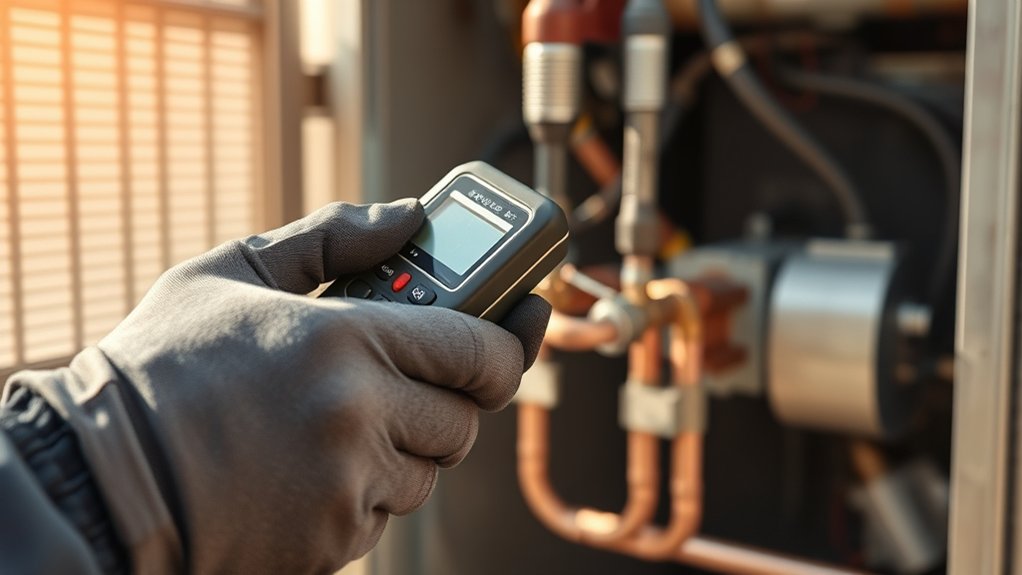
Several factors influence the cost of leak detection and repair in your air conditioning system, directly affecting your overall bill.
Leak detection typically ranges from $100 to $700, depending on diagnostic methods and system complexity.
Repair costs vary. Minor refrigerant leaks usually cost $200 to $500, while moderate leaks can reach $500 to $1,000, especially when valves or connections require fixing.
Regular inspections help homeowners avoid unexpected high refill costs by catching issues early.
Consider these key points: Minor leaks are less expensive to repair but still impact efficiency.
Moderate leaks may require more extensive repairs, increasing costs.
Regular inspections reduce the risk of severe leaks and major expenses.
Staying proactive with leak detection saves money and maintains system performance.
What You’ll Pay for Labor and Service Fees
When you schedule a service for your air conditioner, expect to pay labor costs ranging from $75 to $150 per hour. The exact price depends on the technician’s expertise and how complex the job is.
Service call fees usually run between $75 and $200. These fees cover travel and the initial diagnostics.
Emergency service requests can bump labor rates up by 25% to 50%. Some HVAC technicians offer flat fees for refrigerant refill services, which combine labor and materials. This way, you get more predictable costs.
Geographic location also affects fees, but we’ll cover that later.
| Service Type | Typical Cost Range |
|---|---|
| Labor Costs (per hour) | $75 – $150 |
| Service Call Fees | $75 – $200 |
| Emergency Service | +25% to +50% on labor |
Hiring an experienced professional guarantees efficient, accurate service.
How Location and Market Supply Influence Freon Prices
Although Freon prices depend on multiple factors, location and market supply play pivotal roles in determining your costs. Urban areas often face higher Freon prices due to greater demand and living expenses.
Moreover, refrigerant availability greatly impacts pricing, especially for phased-out substances like R22 and R410A.
Consider these influences on your Freon costs:
- Limited R22 supply pushes prices above $400 per pound, especially where demand remains high.
- Market supply constraints for R410A, halted since January 2025, drive local prices between $199 and $250 per pound.
- Environmental regulations vary by location, affecting compliance costs and the availability of newer refrigerants like R454B.
Understanding these factors helps you anticipate fluctuations in Freon prices based on your location and current market supply conditions.
Why Environmental Regulations Matter for Freon Availability
You need to understand how environmental regulations directly limit the supply of common refrigerants like R-22 by enforcing a phased-out production timeline.
Basically, these rules don’t just cut down availability—they also increase compliance costs, which drives prices up sharply.
So, if you want to stay compliant, you’ve got to balance the rising expense of older refrigerants with the option of investing in newer, eco-friendly alternatives.
It’s all about finding the right mix that works for you while keeping up with the changing regulations.
Regulatory Impact On Supply
Since environmental regulations target ozone depletion and greenhouse gas emissions, they’ve drastically reshaped the availability of common refrigerants like Freon. The regulatory impact has limited production and importation of R-22 refrigerant, causing its availability to plummet and prices to soar.
Similarly, restrictions on R410A and the changeover toward eco-friendly refrigerants affect market pricing and supply chains.
You’ll notice these key effects:
R-22 refrigerant is scarce and costly due to halted production as of 2020.
Production of R410A ceased in January 2025, tightening supply further.
Shifting to eco-friendly refrigerants like R32 and R454B increases upfront costs, reflecting stricter environmental regulations.
Understanding this helps you anticipate fluctuations in Freon pricing driven by regulatory shifts and supply limitations.
Phase-Out Of R-22
The phase-out of R-22 refrigerant marks a significant shift in Freon availability driven by environmental regulations targeting ozone depletion. Since 2020, the U.S. halted R-22 production and importation, causing refrigerant refills to become scarce and expensive. By 2026, prices surged to over $400 per pound.
If you own older systems dependent on R-22, you’ll face rising costs that can make repairs less economical than replacements.
Environmental regulations have pushed the HVAC industry toward eco-friendly refrigerants like R-410A and R-454B, which offer more availability but still affect overall expenses.
These changes force you to reconsider maintenance strategies carefully. You’ll need to balance the higher costs of maintaining R-22 systems against the long-term benefits of upgrading to units compatible with newer, environmentally compliant refrigerants.
Environmental Compliance Costs
Although environmental regulations aim to protect the ozone layer, they directly affect Freon availability and costs by restricting the production and import of traditional refrigerants like R-22. This leads to R-22 scarcity, driving refrigerant prices higher and increasing your Freon refill cost.
Compliance costs for manufacturers and HVAC systems providers also add to these expenses.
As a result, you’ll see a shift toward eco-friendly refrigerants such as R-454B and R-32. These come at premium prices due to demand and regulatory compliance.
Key impacts include:
- Limited R-22 supply causing steep price rises
- Higher costs for eco-friendly refrigerants required by regulations
- Added compliance costs passed on to consumers through service fees
All these factors make environmental regulations a critical driver of refrigerant pricing.
Emergency Repairs: When Freon Refills Get Expensive
When you need an emergency Freon refill, expect to pay a premium that can range from $600 to $1,200. This is because of urgent service requirements and potential overtime labor.
Emergency repairs often include higher service call fees, usually between $75 and $200. This reflects the limited availability of licensed HVAC professionals during off-hours.
If your system has refrigerant leaks or uses scarce refrigerants like R-22, the Freon refill cost can go up even more. It’s really important to address system needs promptly because delaying maintenance can lead to higher energy bills and more extensive damage.
A licensed HVAC professional will diagnose leaks and recharge the system accurately. But keep in mind, emergency repairs cost more because of the urgency and specialized labor involved.
Planning regular maintenance can help you avoid these costly emergency situations. It’s always better to stay ahead than to deal with surprise expenses later on.
Older AC Systems and Their Higher Freon Costs
If your air conditioning system is older, you’re likely facing higher Freon costs due to the use of R-22 refrigerant. This type of refrigerant has become scarce and expensive. Environmental regulations have phased out R-22, driving prices between $120 and $400 per pound.
Maintaining older AC systems often means dealing with frequent refrigerant leaks and increased maintenance. The typical recharge can exceed $1,000 depending on the amount of refrigerant needed.
Consider these factors:
- R-22 scarcity leads to steep costs for refills and repairs.
- Refrigerant leaks in aging systems raise maintenance expenses.
- Upgrading to efficient models using modern refrigerants like R-410A helps reduce long-term costs.
It’s worth weighing the escalating expenses of keeping your older AC system against the financial benefits of upgrading.
Sometimes, investing in a new system pays off in the long run.
Simple Maintenance Tips to Reduce Freon Expenses
Since Freon expenses can quickly add up, you can greatly reduce costs by performing simple maintenance tasks regularly. Prioritize regular maintenance like changing air filters every 1-3 months to sustain system efficiency and prevent refrigerant leaks.
It’s also a good idea to schedule annual professional maintenance. This helps catch issues early and apply preventive measures. Plus, addressing minor cooling problems promptly can save you from costly repairs down the line.
| Maintenance Task | Benefit | Frequency |
|---|---|---|
| Change Air Filters | Maintains airflow, prevents leaks | Every 1-3 months |
| Professional Maintenance | Early detection of issues | Annually |
| Clear Outdoor Unit Area | Optimizes cooling performance | As needed |
Frequently Asked Questions
How Long Does a Typical Freon Refill Last in an Air Conditioner?
A typical Freon refill lasts between one to three years, depending on your system type and usage patterns. Your Freon lifespan shortens if leaks go undetected, so frequent leak detection is vital.
Maintenance importance can’t be overstated; regular checks help extend refill frequency by preventing losses.
Regional climate also affects durability. Hotter areas may require more frequent refills.
Staying on top of these factors guarantees your AC runs efficiently and your Freon lasts longer.
Can I Refill Freon Myself Without Professional Help?
You shouldn’t attempt DIY Freon refilling because of legal regulations and safety precautions. The cost of tools alone is pretty high, and without proper leak detection methods, you could end up hurting your system’s performance.
Certified technicians use specialized equipment and maintenance tips to make sure everything is handled safely and your AC runs at its best.
If you try refilling it yourself, you might cause leaks or contamination, which messes with your AC’s efficiency and safety.
What Are the Health Risks Associated With Freon Exposure?
You should handle Freon with care because Freon exposure can lead to serious health effects.
Breathing it may cause respiratory issues like lung irritation or difficulty breathing. Neurological symptoms such as dizziness or impaired motor function can also occur, especially with long term risks.
To protect yourself, follow safety precautions strictly and adhere to regulatory guidelines designed to minimize exposure and health hazards.
Always use proper equipment and ventilation when working with Freon. It’s really important to keep these safety measures in mind to stay safe.
How Do Seasonal Changes Affect Freon Efficiency and Cost?
Seasonal temperature and humidity levels directly impact Freon efficiency, causing cost fluctuations. During the hot months when usage peaks, your system works harder. This can lead to more refrigerant leaks and lower energy efficiency.
If you don’t keep up with regular system maintenance, these leaks can get worse. That means your Freon costs will go up.
On the flip side, cooler seasons lower the demand on your system, but you still need to check it to keep everything running smoothly.
By catching refrigerant leaks early and scheduling maintenance when the seasons change, you can keep your system efficient. This helps you control expenses all year long.
It’s a simple way to make sure you’re not paying more than you need to.
Are There Eco-Friendly Alternatives to Traditional Freon?
Yes, you can choose eco-friendly refrigerants like R-32 and R-454B, which reduce environmental impact and comply with regulatory standards.
These alternatives offer better energy efficiency, aligning with market trends and increasing consumer awareness.
When you compare costs, you’ll find that while initial expenses may be higher, long-term savings and sustainability benefits outweigh them.
Plus, exploring alternative cooling methods can further optimize efficiency and reduce your carbon footprint.
Conclusion
When you consider that an average AC system can lose up to 20% of its refrigerant annually due to leaks, it’s clear how costs can quickly add up. Understanding factors like system size, refrigerant type, and repair needs helps you manage expenses effectively.
By staying proactive with maintenance and addressing leaks promptly, you’ll keep Freon costs in check. This way, your air conditioner runs efficiently without unexpected financial hits.