How Did Willis Carrier Invent the Air Conditioner Step by Step?
You start by understanding the problem Willis Carrier faced: high humidity ruining printing quality. He applied psychrometrics to measure temperature and moisture. Then he designed a system using a vapor compression refrigeration cycle with key parts like the compressor, condenser, evaporator, and expansion valve to cool and dehumidify air.
After testing in 1902 and patenting his invention in 1906, Carrier’s innovation transformed industrial climate control. It set standards for modern air conditioning and laid the groundwork for widespread comfort improvements ahead.
The Problem Willis Carrier Needed to Solve
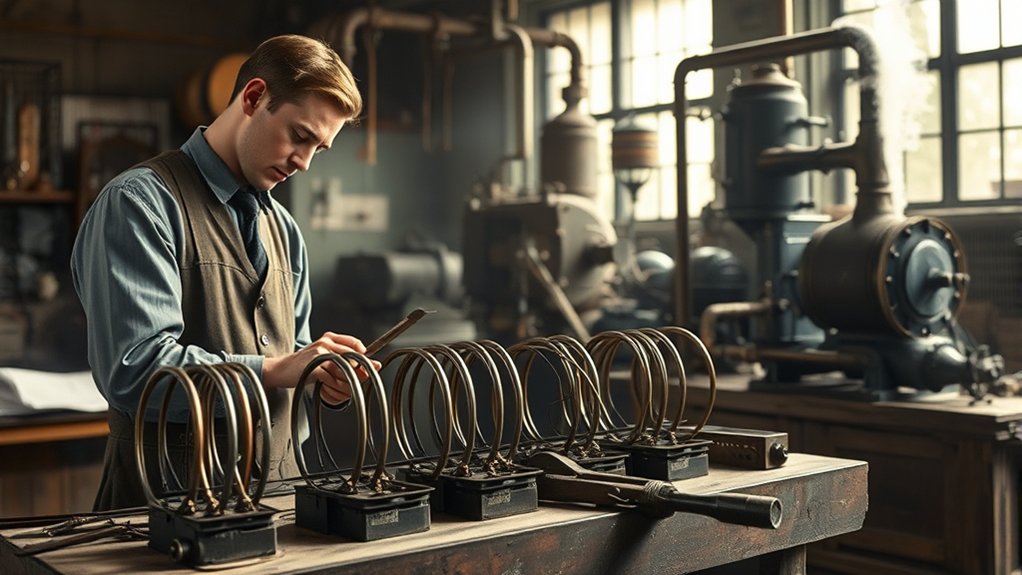
Humidity posed a critical challenge for Willis Carrier when he addressed the issues at the Sackett-Wilhelms Lithographing and Publishing Company in Brooklyn. High humidity in the printing plant caused paper to warp and ink to smear, directly affecting product quality.
You’d quickly realize that traditional ventilation couldn’t maintain consistent humidity control.
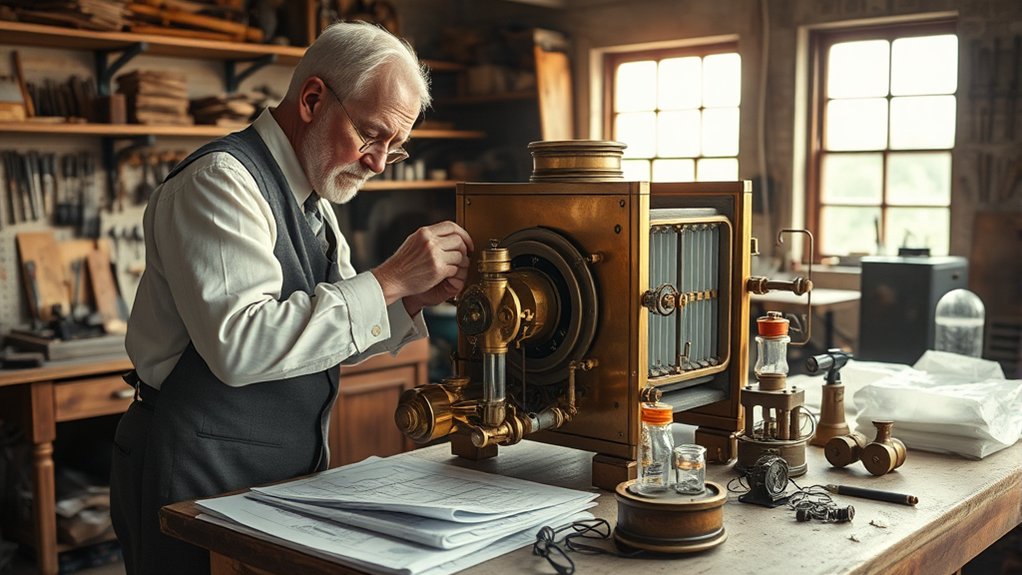
Carrier designed a mechanical system in 1902 that circulated air over chilled coils, lowering both temperature and moisture levels effectively. This innovative approach formed the basis of his air conditioning apparatus, which he patented in 1906.
In 1902, Carrier’s chilled coil system revolutionized air control, paving the way for modern air conditioning.
His invention did more than just cool the air; it controlled humidity precisely, transforming indoor environments.
By solving this specific industrial problem, Carrier laid the groundwork for modern HVAC technology and boosted productivity in the printing industry.
It’s pretty amazing how one solution can change so much, right?
How Carrier Applied Psychrometrics to Air Conditioning
Although early air conditioning systems improved comfort, they lacked a precise scientific framework to enhance performance.
Willis Carrier filled this gap by developing the Rational Psychrometric Formulae in 1911, which became a cornerstone in HVAC engineering.
This formula allowed you to quantify the relationships between temperature and humidity accurately. You could also calculate air density changes to predict indoor climates precisely.
Plus, it helped design air conditioning systems that control both moisture and temperature effectively.
All of this meant you could enhance comfort and productivity by maintaining ideal indoor environmental conditions.
It was a game changer in how we understand and manage indoor air quality.
Understanding Carrier’s Vapor Compression Refrigeration Cycle

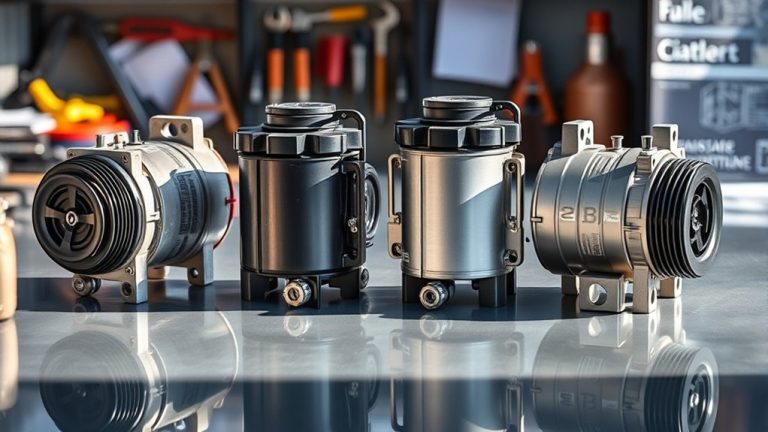
Because managing indoor air temperature and moisture requires a reliable mechanism, Willis Carrier designed his air conditioner around the vapor compression refrigeration cycle. This cycle involves four key stages: compression, condensation, expansion, and evaporation.
You start with the refrigerant gas being pressurized in the compressor, which raises its temperature and pressure.
Next, the hot, high-pressure gas moves through the condenser coils, where it releases heat to the outside air and condenses into a liquid.
The refrigerant then passes through an expansion valve, dropping its pressure and temperature before entering the evaporator coil.
There, the cold refrigerant absorbs heat from indoor air, evaporating back into gas. This results in effective cooling and dehumidification.
Carrier’s design efficiently harnesses this cycle to control indoor climate. It’s a clever way to keep spaces comfortable, no matter the weather outside.
Designing the First Air Conditioning System
You’re dealing with some serious humidity control problems that were messing up industrial processes at the Sackett-Wilhelms company.
To fix this, Carrier came up with an innovative system that included key parts like a compressor, condenser coil, and evaporator coil.
These components worked together to manage both temperature and moisture.
When you understand how these pieces function, it becomes clear how the first air conditioning system successfully balanced environmental conditions.
Humidity Control Challenges
When Willis Carrier faced the challenge of controlling humidity at the Sackett-Wilhelms Lithographing and Publishing Company in 1902, he developed a groundbreaking approach that transformed air treatment.
You’ll see how his invention addressed the critical balance of moisture and temperature, which is essential for stable printing conditions.
Carrier’s air conditioning system achieved precise humidity control by identifying moisture as the root cause of ink smudging and paper expansion.
He designed a method to cool air by passing it over chilled coils, which removed excess moisture.
He also applied a vapor compression refrigeration cycle to regulate both temperature and humidity.
In 1906, Carrier secured a patent for this “Apparatus for Treating Air,” which established the foundation for modern air conditioning.
This innovation tackled humidity challenges directly and revolutionized industrial environments.
It’s amazing how one idea changed the way we control indoor air quality today.
Early System Components
Willis Carrier’s first air conditioning system, designed in 1902, combined several mechanical components to regulate indoor temperature and humidity effectively.
You’ll notice that this early air conditioning system employed the vapor compression refrigeration cycle. This involves compressing, condensing, expanding, and evaporating a refrigerant to absorb and remove heat.
Willis Carrier integrated a fan to circulate air over cooled coils containing the refrigerant. This enabled the system to reduce humidity by extracting moisture from the air.
This precise control of humidity and temperature not only improved comfort but also enhanced industrial processes, particularly at the Sackett & Wilhelms printing plant.
Carrier’s 1906 patent for this innovative apparatus formalized the design. It set a foundation for modern air conditioning technology and its widespread industrial applications.
Pretty impressive how that early work still influences what we use today!
Testing and Installing the First System in 1902
In 1902, Carrier engineered the first modern air conditioning system specifically to regulate humidity and temperature at the Sackett & Wilhelms Lithographing and Publishing Company in Brooklyn, NY.
Willis Carrier installed a system using water-cooled coils to remove moisture, effectively controlling humidity and preventing paper warping. This innovation marked a key advancement in environmental control.
Key steps included designing cooling coils to extract moisture from the air. The unit was installed in July 1902, achieving a 20°F temperature reduction.
They also incorporated a fan to circulate air over the coils for efficient cooling.
By 1906, Carrier secured a patent, formalizing the invention’s significance. This installation demonstrated practical humidity control and laid the foundation for modern air conditioning technology.
It was quite the breakthrough at the time!
Early Challenges Carrier Overcame
You’ll see how Carrier tackled the tough problem of controlling humidity in industrial environments by inventing a new mechanical system.
He ran into some big engineering challenges, especially since the technology available at the time was pretty limited. That really pushed him to come up with the vapor compression refrigeration cycle.
On top of that, his early work wasn’t just about the tech—it was also about proving that air conditioning actually had practical value in industry.
That was a crucial step because people were pretty skeptical at first, and he’d to show them it was worth adopting.
Humidity Control Breakthrough
Although controlling humidity posed complex challenges, Carrier tackled them head-on by inventing the first modern air conditioning system in 1902 to address ink smudging and paper warping at a printing plant.
Willis Carrier’s invention focused on precise humidity control to improve industrial processes and comfort.
Key milestones include:
- Patent of the “Apparatus for Treating Air” in 1906, introducing spray-type air conditioning that regulated both temperature and humidity.
- Development of the Rational Psychrometric Formulae in 1911, enabling accurate calculation of air properties and energy consumption.
- Installation of the first residential air conditioner in 1914, proving the system’s ability to enhance comfort in homes.
- Introduction of centrifugal chillers by 1922, greatly improving cooling efficiency and overcoming early humidity control issues.
These breakthroughs laid the foundation for modern air conditioning systems.
It’s pretty amazing how these innovations still impact our comfort today.
Engineering Design Challenges
Mastering humidity control was only part of Carrier’s challenge. Designing a reliable mechanical system brought its own set of engineering hurdles. Willis Carrier tackled these design challenges by developing the first modern air conditioning system in 1902, which used the vapor compression refrigeration cycle to regulate temperature and moisture.
You’d have to refine the cooling capacity and efficiency to meet industrial demands. Carrier addressed this through lots of trial and error, experimenting until he got it right. His patented apparatus, secured in 1906, integrated a fan and coil system to optimize heat exchange, which was vital for precise humidity control.
Then, in 1911, Carrier introduced the Rational Psychrometric Formulae. This allowed you to accurately calculate air properties, making system design even better.
Overcoming these challenges was essential to turning air conditioning from just an idea into a practical, working technology.
Early Industry Applications
Willis Carrier overcame several critical challenges when applying his air conditioning system to early industrial settings. His invention initially addressed humidity control issues at Sackett & Wilhelms, improving print quality by stabilizing air conditions. Carrier’s first modern air conditioning system utilized the vapor-compression refrigeration cycle, patented in 1906, ensuring reliable temperature and humidity regulation.
You can appreciate his key breakthroughs. First, developing the Rational Psychrometric Formulae (1911) to precisely control humidity and temperature.
Then, demonstrating air conditioning’s industrial value at Sackett & Wilhelms. He also expanded applications beyond industry, particularly at the Rivoli Theater in 1922 for public comfort.
And he overcame skepticism through public showcases, such as the 1904 St. Louis World’s Fair. These efforts established air conditioning as an essential technology across diverse industrial settings.
It really changed how environments were controlled and improved many industries in the process.
How Carrier’s 1906 Patent Advanced Air Conditioning Technology
One key innovation from Carrier’s 1906 patent was the introduction of a mechanical system that precisely controlled both temperature and humidity through the vapor compression refrigeration cycle.
Willis Carrier’s patent detailed how refrigerants absorb heat and moisture, enabling an efficient cooling process that was unprecedented at the time.
This breakthrough laid the foundation for the modern air conditioning system, allowing environments to be stabilized with accuracy not previously possible.
By integrating humidity control with cooling, Carrier’s design addressed critical industrial needs, especially in sectors like printing and textiles.
The patent’s clear articulation of this method marked a significant advancement, influencing future developments in air conditioning technology.
Understanding this patent helps you appreciate how Carrier’s work transformed air treatment into a reliable, controllable process essential for both industry and comfort.
Expanding Air Conditioning Beyond Industrial Use
Although air conditioning was initially designed for industrial purposes, its applications quickly expanded into public and residential spaces, transforming everyday life.
Willis Carrier pioneered this shift by adapting the air conditioning unit for diverse environments beyond factories.
You can see this expansion clearly in theaters. The first air-conditioned theater, the Metropolitan Theater (1922), boosted summer attendance by enhancing audience comfort.
Centrifugal chillers, introduced in 1922, enabled large-scale cooling. This made public venues like Madison Square Garden much more comfortable.
By the 1930s, air conditioning became essential in department stores. It helped attract shoppers during the hot months.
Affordable window units appeared in the late 1940s. This brought cooling to average households and broadened market access.
This progression marked air conditioning’s evolution from an industrial necessity to daily convenience. It really changed the way people live and spend their time.
How Carrier’s Innovations Set Modern AC Standards
You’ll find that Carrier’s Rational Psychrometric Formulae gave a precise way to balance temperature and humidity. This method quickly became a cornerstone in AC design.
Then, his spray-type air conditioning came along, bringing efficient moisture control that really improved indoor air quality.
On top of that, central station humidifying systems helped standardize climate regulation across large spaces.
Altogether, these innovations played a big role in shaping the modern HVAC practices we rely on today.
Rational Psychrometric Formulae
Because controlling indoor air quality requires a precise understanding of temperature, humidity, and air pressure interactions, Willis Carrier developed the Rational Psychrometric Formulae in 1911. This breakthrough provided a scientific basis for analyzing air and moisture properties. It’s essential for effective climate control.
With these formulae, you can calculate the interplay between humidity and air pressure accurately. You can also design HVAC systems that maintain consistent indoor comfort. Plus, they help improve energy efficiency by optimizing air treatment processes.
These formulae have helped standardize modern air conditioning practices across residential and industrial sectors. Carrier’s Rational Psychrometric Formulae laid the foundation for HVAC engineering. They enable precise climate control and have advanced energy-conscious, modern air conditioning technologies still used today.
Spray-Type Air Conditioning
When Willis Carrier patented his “Apparatus for Treating Air” in 1906, he introduced a spray-type air conditioning system that precisely controlled humidity and temperature. This innovation transformed indoor climate management in ways people hadn’t seen before.
It directly addressed humidity issues that were messing up the quality of printed materials at the Sackett & Wilhelms plant. Carrier’s system used water sprays to cool and dehumidify air efficiently, setting a whole new standard in air treatment.
Then, in 1911, Carrier applied the Rational Psychrometric Formulae, which refined how humidity control calculations were done. This made his system even more precise and reliable.
By 1925, Carrier’s centrifugal chillers showed that air conditioning could be scaled up efficiently for big places like Madison Square Garden.
These developments laid the groundwork for what we now know as modern HVAC systems.
All in all, Willis Carrier’s spray-type air conditioning and his later innovations truly revolutionized how we control indoor environments.
Central Station Humidifying
Although many early air conditioning efforts focused on temperature control, Willis Carrier recognized that managing humidity was just as important for comfort and industrial processes. In 1906, he developed the first central station humidifying system. This allowed for precise humidity control in large industrial settings, like the Chronicle Cotton Mills. This innovation was a big step forward in HVAC systems.
Carrier didn’t stop there. In 1911, he introduced the Rational Psychrometric Formulae, which helped engineers measure temperature and humidity effects accurately. His work made it easier to control air quality and comfort, influencing the widespread use of air conditioning in public spaces such as theaters.
Some key contributions include:
- Development of central station humidifying for large-scale humidity control
- Application in industrial settings to optimize conditions
- Introduction of the Rational Psychrometric Formulae for precise calculations
- Foundation for modern HVAC systems emphasizing humidity control
Legacy of Willis Carrier’s Air Conditioning Invention
Willis Carrier’s invention of the modern air conditioning system fundamentally transformed how we manage indoor environments by precisely controlling temperature and humidity. His initial solution for humidity control at the Sackett & Wilhelms plant evolved into a broader technology that improved comfort and productivity across industries.
By founding the Carrier Engineering Corporation in 1915, Willis Carrier set up a platform that helped air conditioning move into commercial and residential use.
Willis Carrier’s 1915 company paved the way for air conditioning in homes and businesses.
Then, the introduction of centrifugal chillers in 1922 expanded large-scale cooling capabilities. This really solidified Carrier’s legacy in industrial applications.
Today, about 90% of American homes use air conditioning, showing just how widespread Carrier’s innovation has become.
His work didn’t just revolutionize environmental control; it also shaped modern architecture, workplace efficiency, and everyday living standards across the U.S. and beyond.
Frequently Asked Questions
What Inspired Willis Carrier to Pursue Engineering?
You’ll find Willis Carrier’s engineering motivation rooted in his childhood experiences and technological curiosity, which fueled his innovative thinking.
His academic influences at Cornell sharpened his skills, while summer heat and industrial needs highlighted practical problems to solve.
These factors combined, pushing him toward engineering.
You can see how his passion grew from recognizing challenges and applying scientific principles, driving him to create solutions that transformed industries.
How Did Carrier’s Invention Impact Everyday Home Life?
Like discovering a modern-day oasis in your own home, Carrier’s invention transformed home comfort by mastering temperature control and boosting indoor air quality.
You now enjoy seasonal adaptation effortlessly, with energy efficiency reducing costs.
This shift brought health benefits, cutting heat-related illnesses, while encouraging lifestyle changes.
Think open windows or longer summers indoors.
Ultimately, his innovation reshaped how you live, making homes safer, cooler, and healthier year-round.
What Materials Were Used in the First Air Conditioner?
You’ll find that the first air conditioner used refrigerant types like ammonia and water, which were essential for controlling humidity.
Cooling coils made of metal helped with heat exchange, making the whole process more efficient. Electric motors powered fans that circulated air through duct systems.
Insulation materials were used to minimize unwanted heat transfer, which boosted the system’s overall performance.
All these components worked together to regulate both temperature and moisture.
It’s pretty interesting how Carrier’s design thoughtfully combined materials and mechanics to make it all happen.
Did Carrier Face Any Personal Challenges During His Invention?
You’d find that Carrier faced significant personal struggles, including financial obstacles as he sought funding.
Educational challenges pushed him to innovate despite limited precedents, while workplace conflicts arose from skepticism about his ideas.
Societal expectations of the era added pressure, and health issues occasionally strained his focus.
However, family support helped him persevere, balancing these challenges with a drive to improve climate control for broader public benefit.
How Did Carrier’s Invention Influence Other Industries?
Carrier’s climate control cleverly catalyzed comfort technology across countless careers.
You’ll notice improved air quality and energy efficiency in industrial cooling, boosting manufacturing processes. This breakthrough brought better business by balancing temperature, which enhanced productivity and economic impact.
You benefit from cooler retail environments and data centers, where precise climate control preserves performance.
Conclusion
You can appreciate Willis Carrier’s invention by noting that his 1906 patent reduced indoor humidity from over 70% to below 50%. This change revolutionized comfort and industrial processes.
By applying psychrometrics and refining vapor compression cycles, he transformed air conditioning from a niche solution into a global standard. His innovations didn’t just solve immediate problems.
They also set the foundation for modern climate control. Today, his work impacts billions of lives and industries worldwide. It’s pretty amazing when you think about it!