How Many Watts Does a Window Air Conditioner Use: 7 Facts
A window air conditioner uses between 500 and 1,500 watts, depending on its BTU rating and energy efficiency. Small units (5,000 to 6,000 BTUs) consume around 500 to 700 watts, while medium models (8,000 to 10,000 BTUs) draw 700 to 1,000 watts. Larger units (12,000+ BTUs) demand up to 1,500 watts.
Your AC’s efficiency and how many hours you use it directly affect energy consumption and costs. So, keeping an eye on both can help you save money. Proper generator sizing and solar options also play a role in managing your power needs.
Keep exploring to find the best ways to optimize your unit’s power use and boost your savings. It’s all about making your air conditioner work smarter for you!
Understanding Window AC Wattage
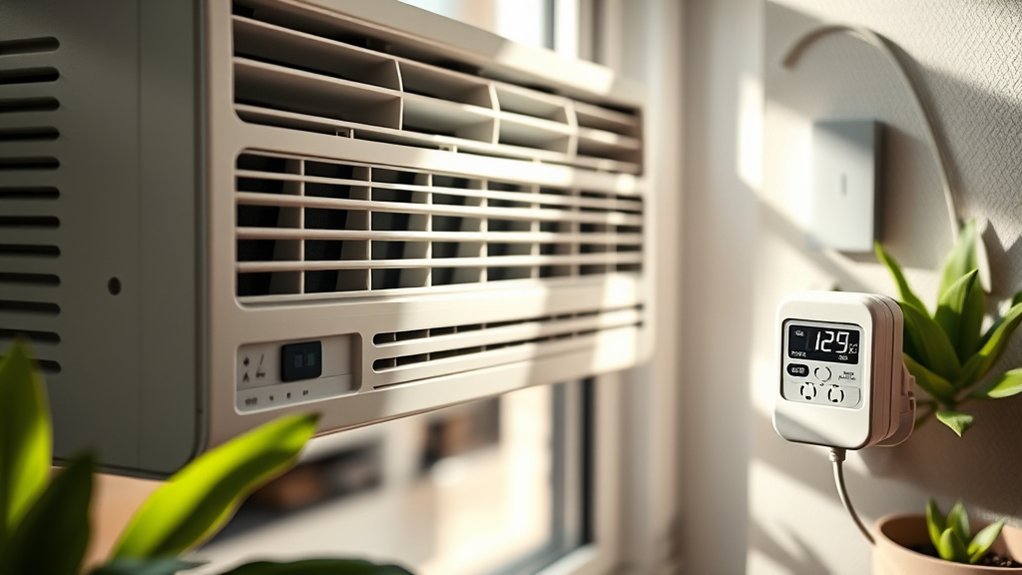
Although window air conditioners vary widely in size and capacity, they typically consume between 500 and 1,500 watts of power. This depends largely on their BTU rating and energy efficiency.
Window air conditioners usually consume 500 to 1,500 watts, depending on size and efficiency.
You’ll find small window AC units with cooling capacities of 5,000–6,000 BTUs use approximately 500 to 700 running watts. Larger units exceeding 12,000 BTUs demand 1,000 to 1,500 watts.
The window AC’s wattage directly relates to energy consumption and influences electricity costs. Higher EER (Energy Efficiency Ratio) values mean the unit uses fewer watts to deliver the same cooling capacity. This helps optimize energy efficiency.
Running watts represent the continuous power required during operation, which is different from the higher starting watts when the unit first turns on.
Keeping an eye on these numbers helps you estimate your window AC’s impact on your monthly electricity bill more precisely.
How BTU Ratings Affect Window AC Power Use
You’ll notice that a window AC’s BTU rating directly affects how much power it uses.
Basically, the higher the BTUs, the more watts it needs to cool bigger spaces effectively. For instance, a 5,000 BTU unit usually consumes around 500 to 700 watts.
On the other hand, a 12,000 BTU model can draw anywhere from 1,000 to 1,500 watts.
But here’s something to keep in mind: units with higher Energy Efficiency Ratios (EER) actually use less electricity for each BTU.
BTU And Power Correlation
Three key factors determine how much power a window air conditioner consumes: its BTU rating, the Energy Efficiency Ratio (EER), and the size of the space it cools.
The BTU rating directly reflects the cooling capacity and correlates with power usage in watts. Generally, higher BTU means increased energy consumption.
Consider these typical power draws:
- Small units (5,000–6,000 BTU): 500–700 watts
- Medium units (8,000–10,000 BTU): 700–1,000 watts
- Large units (12,000+ BTU): 1,000–1,500 watts
- Approximate power per BTU: 0.1 watts
Your window air conditioner’s actual power consumption depends on the EER rating, which adjusts efficiency.
A higher EER rating lowers the watts needed for the same BTU, optimizing energy consumption without sacrificing cooling capacity. It’s a great way to keep your energy bills down while staying cool.
Efficiency Impact On Wattage
Understanding how BTU ratings influence power consumption requires examining the efficiency of your window air conditioner. The BTU rating indicates the cooling output, with higher BTU units generally consuming more watts because they need more power.
But here’s the thing—the Energy Efficiency Ratio (EER) plays a critical role in determining actual wattage usage. A window AC with a high EER delivers the same cooling output using fewer watts, which means it’s more efficient and helps reduce electricity costs.
For example, a 12,000 BTU unit with a low EER can consume a lot more watts than a similarly rated unit with a higher EER.
Typical Wattage for Small, Medium, and Large Window ACs
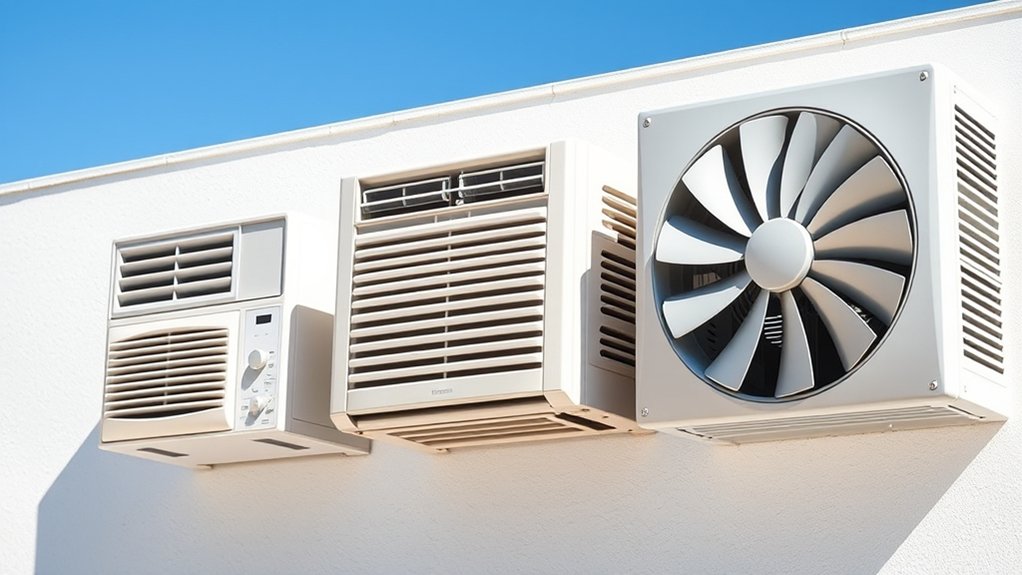
You’ll find that small window AC units typically draw between 500 and 700 watts.
Medium models usually consume somewhere between 700 and 1,000 watts when they’re running.
As for large units, they often require anywhere from 1,000 to 1,500 watts, depending on how efficient they are.
Knowing these ranges can really help you estimate your power needs based on the size of your AC unit.
Small Window AC Watts
Small window air conditioners, typically rated between 5,000 and 6,000 BTUs, consume approximately 500 to 700 watts when operating at full capacity.
Understanding small window AC watts helps you estimate energy consumption and manage your electricity bill effectively.
Key factors influencing window AC uses include:
- BTU window AC rating directly correlates with watts on average consumed.
- Efficiency rating (EER) impacts energy costs by reducing watts needed.
- Small units draw less power compared to larger household appliances.
- Operating at full capacity, these units offer targeted cooling with lower consumption.
Knowing these details can really help you keep your energy use in check without sacrificing comfort.
Medium Window AC Usage
Moving beyond small window air conditioners, medium units typically range from 8,000 to 10,000 BTUs and consume between 700 and 1,000 watts during operation.
For example, a 9,000 BTU medium window AC with an Energy Efficiency Ratio (EER) of 10 uses about 900 watts. Your unit’s actual watts may vary due to factors such as age, maintenance, and external temperatures, which can affect efficiency and cooling capacity.
If you run the medium window AC for eight operating hours daily, expect a monthly energy consumption near 200 kilowatt-hours. To estimate your cost, just multiply this by your local electricity rate.
Always check the unit’s specification label for precise wattage to accurately gauge energy consumption.
Doing this helps you optimize usage based on your cooling needs and efficiency goals. It’s a smart way to keep an eye on your energy bills without sacrificing comfort.
Large Window Power Needs
Although large window air conditioners provide powerful cooling for spacious rooms, they demand considerably higher wattage compared to smaller units. Understanding the power needs helps you manage energy consumption and control energy bills.
Here’s a breakdown of typical wattage for various window AC sizes operating at full capacity:
- Small window ACs (5,000–6,000 BTU) consume 500–700 watts.
- Medium units (8,000–10,000 BTU) use about 700–1,000 watts.
- Large window ACs (12,000+ BTU) require approximately 1,000–1,500 watts, depending on efficiency.
- A 24,000 BTU unit with a 10 EER rating consumes roughly 2,400 watts.
Higher BTU ratings mean more electricity is used, so efficiency really matters.
It’s key to optimizing energy consumption and keeping your power costs down.
Calculating Your Window AC’s Energy Consumption
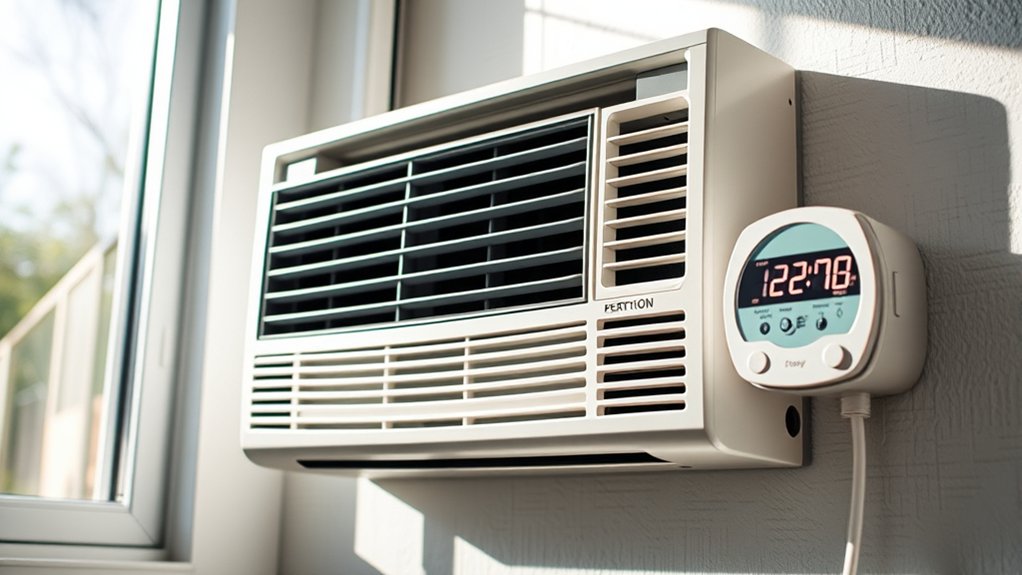
To accurately calculate your window air conditioner’s energy consumption, start by identifying its wattage. This is typically indicated on the unit’s label and is closely tied to its BTU rating. For example, a 5,000 BTU window AC uses about 500 to 700 watts, while a 10,000 BTU unit consumes 1,000 to 1,500 watts.
To calculate daily usage, multiply the running wattage by the hours of operation. For instance, a 900-watt AC running 8 hours daily uses 7.2 kWh.
It’s also important to remember the starting wattage, which can be considerably higher than the running wattage and affects total energy consumption.
Estimating monthly electricity costs involves multiplying daily kWh by the number of days used. This precise approach helps you forecast energy consumption and manage electricity costs effectively.
Choosing a Generator for Your Window AC
When selecting a generator for your window air conditioner, you need to match the generator’s capacity to both the unit’s running and starting wattage to verify reliable operation.
Different air conditioning units have varying energy consumption based on their BTU ratings, affecting the watts required. For example, a 5,000 BTU window AC uses about 1,465 watts, while a 12,000 BTU unit demands up to 3,516 watts.
Air conditioners’ wattage varies with BTU size, from 1,465 watts for 5,000 BTU to 3,516 watts for 12,000 BTU units.
Consider these factors when choosing generator capacity:
- Starting watts peak momentarily, often 20-30% higher than running watts
- Running watts indicate continuous electricity use during operation
- Ascertain generator capacity exceeds the highest starting watt requirement
- Match generator capacity closely with your window AC’s BTU and watt specifications
This guarantees stable power delivery and prevents overload during startup.
It’s important to get this right so your AC runs smoothly without tripping your generator.
Using Solar Generators to Power Your Window AC
Since window air conditioners typically draw between 500 and 1,500 watts depending on their BTU rating, you’ll need a solar generator system that consistently delivers this output.
Solar generators like the Renogy 800W Solar Kit produce 3.5-4 kWh daily under ideal sunlight. This efficiently covers the energy consumption of most window air conditioning units.
Pairing this with sufficient battery storage, such as two Core Mini 12.8V 300Ah batteries, can sustain running the AC for up to 22-23 hours. This setup not only guarantees continuous operation during a power outage but also greatly reduces electricity costs associated with peak summer usage.
For best efficiency, proper installation and regular maintenance of solar components are essential to maximize power output and meet the specific wattage demands based on your AC unit’s BTU rating.
Tips to Lower Your Window AC’s Energy Use
Harnessing solar power effectively supports your window AC’s operation, but reducing its energy use directly improves overall efficiency and lowers consumption. To optimize your unit’s performance and cut watts spent, focus on minimizing energy consumption through practical adjustments.
You can regularly clean or replace air filters to enhance airflow and improve efficiency by up to 15%, which reduces your energy bills.
Also, sealing gaps around the window AC prevents cool air leakage and reduces heat gain, so your unit doesn’t have to work as hard.
Sealing gaps around your window AC stops cool air leaks and lowers heat gain for easier cooling.
Set the thermostat between 26-29°C to lower energy consumption without sacrificing comfort.
Using ceiling fans helps distribute cooled air evenly, which lets you raise the thermostat setting and save even more energy.
Applying these tips helps you reduce energy use, improve efficiency, and save on energy bills effectively.
It’s all about making small changes that add up to big savings.
Frequently Asked Questions
Can Window AC Units Be Recycled or Disposed of Safely?
Yes, you can recycle or dispose of window AC units safely by following local regulations and using approved recycling programs.
These programs guarantee hazardous materials like refrigerants are handled properly to minimize environmental impact. You should take your unit to certified recycling centers where professionals manage unit components and hazardous materials safely.
Also, exploring eco-friendly options like community initiatives or manufacturer take-back programs supports responsible disposal methods and reduces environmental harm.
It’s really about making sure the materials are treated the right way so our environment stays protected.
How Does Humidity Affect Window AC Performance?
Humidity levels directly impact your window AC’s cooling efficiency by increasing the workload for moisture removal.
Higher humidity forces the unit to run longer in dehumidification mode, which raises energy consumption.
Excess moisture can cause condensation issues, disrupting air flow and reducing indoor comfort.
So, it’s important to keep humidity in check to avoid these problems.
Maintaining ideal humidity levels between 30% and 50%, along with regular maintenance, helps your AC operate efficiently.
This balance prevents strain on the unit while ensuring effective dehumidification and consistent cooling performance.
Are Window AC Units Noisy During Operation?
Window AC units hum like a gentle breeze or roar like distant thunder, depending on noise levels.
You’ll notice quieter models use advanced sound insulation and vibration reduction to tame compressor operation and fan speed.
During nighttime operation, choosing units labeled “low noise” enhances your user experience.
Regular maintenance tips, like cleaning filters, improve energy efficiency and reduce noise.
When making product comparisons, consider these factors to find a balance between cooling power and quiet performance.
It’s all about keeping cool without the extra noise!
What Are the Common Repair Issues for Window Air Conditioners?
Common repair issues for window air conditioners include airflow problems from dirty filters, thermostat malfunctions that cause inaccurate temperature control, and drainage issues like blocked condensate drains.
Electrical problems such as blown fuses can also disrupt operation. These symptoms usually reduce cooling efficiency and can increase repair costs.
Regular maintenance is key. Cleaning filters and checking drainage regularly can help prevent many of these problems.
You can try some DIY fixes on your own, but often replacement parts and professional help are needed.
Getting professional service ensures your unit runs at peak performance and helps avoid costly damage down the road.
Do Window AC Units Require Professional Installation?
You don’t necessarily need professional skills for window AC installation. Many people opt for DIY installation to save on installation costs and time.
Just make sure to prepare the site properly, meet electrical requirements, and follow safety standards carefully.
Professionals can help guarantee compliance, which reduces risks related to warranty issues. After installation, it’s often recommended to check the seals and drainage to keep things running smoothly.
If you have a larger unit or a more complex setup, getting professional advice can really pay off. It helps optimize performance and avoid costly mistakes down the line.
Conclusion
While a small window AC might sip just 500 watts, a larger unit can gulp over 1500 watts. That shift can really impact your energy costs.
You can’t ignore how BTU ratings directly influence power draw. So, calculating exact consumption is key to avoiding surprises.
Choosing the right generator, whether conventional or solar, can mean the difference between constant comfort and unexpected outages. By understanding these factors, you’re empowered to balance efficiency, cost, and reliability with precision.